
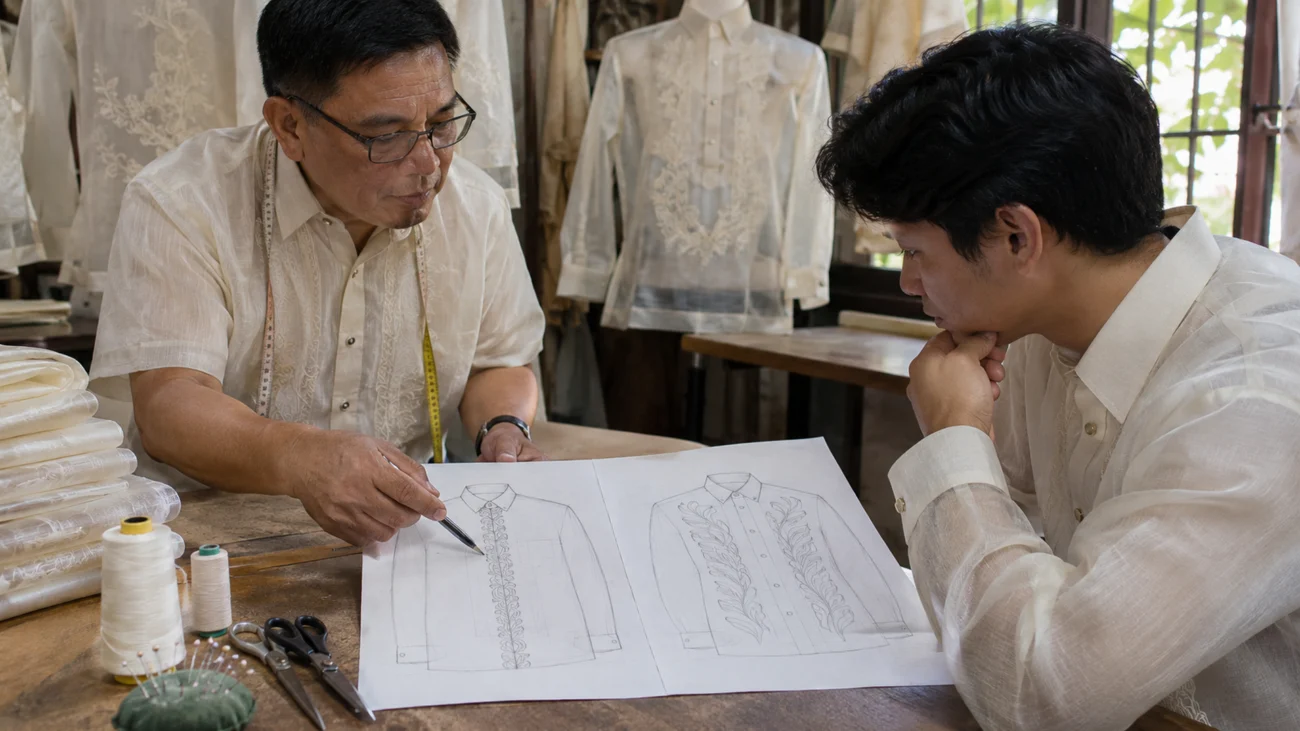
For a family celebration, the wearer of a barong Tagalog may know exactly how much embroidery he likes even when he has yet to learn the artisan’s terms. Start by pointing to the decorated front, the pechera. Compare two complete fronts and mark where you want the needlework to begin, spread and stop. Give that outline to the artisan. The drawing leaves the maker room to propose the stitches and motifs that will work there.
Featured image generated with AI.
Find the front panel before you study a flower
In its account of Philippine weaving in the time of Rizal, the National Museum of the Philippines uses pechera for the front panel of the barong and describes decorated examples, including floral work and openwork. That gives you a word to use across the counter. Ask the person showing you the garment what their workshop calls the treatment in front of you. A term on a historical object label may cover different ground from a term on a contemporary order form.
Lay the first barong against the lining or undershirt colour you expect to wear. Stand far enough back to see collar and hem at once. Start at the opening. Is the decorated area a narrow column alongside it? Does the work widen as it moves down the chest? Where does the lowest part sit in relation to the end of the opening? A close photograph of a single blossom cannot answer those questions.
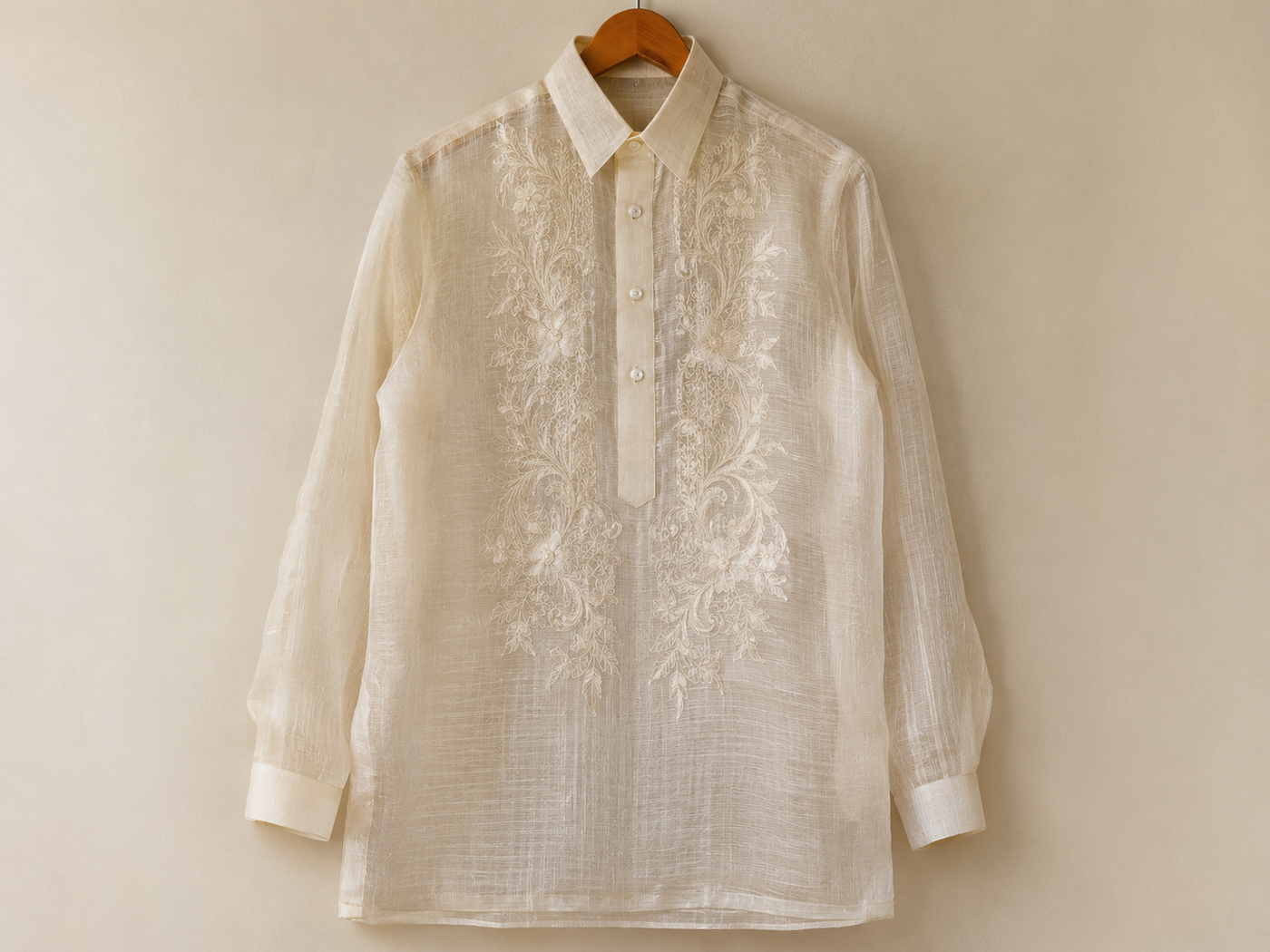
Try the second front under the same light. Cover the lower half of both garments briefly with a plain sheet of paper. Now reveal the lowest part of the embroidery. In one, the uncovered section may bring the eye down both sides in parallel. In another, a few scattered motifs may give the front a much broader outline. Which arrangement would you enjoy seeing in a family group photograph, where the individual stitches may be too small to read?
Ask what the maker means by the name
A useful contemporary comparison is Pineapple Industries’ Arland barong. Its order description uses “full open pechera” in describing a full-length front opening. If you say you want a “full front,” the person taking the order could reasonably think you mean how the shirt opens. Point separately to the line of buttons and the area of decoration. Ask which word the maker uses for each decision.
Compare Arland with the same maker’s Rachelle design, which combines a half-opening front with embroidered flowers, fans and leaves. Trace the extent of those motifs separately from the end of the opening. Ask to see a sample the workshop can identify. “Who designed this layout, and which parts were embroidered by hand or machine?” is a question someone involved in producing the garment can answer. An evenly repeated shape or a slight irregularity is insufficient evidence by itself. If the person at the counter is unsure, ask whether the embroiderer can supply a description you may keep, including the name they would like used for their work.
If a relative has offered an older barong as a reference, ask what you may photograph and what the family wants kept private. A picture showing the extent of a panel can guide a new design without copying a particular motif. A similar way of following the decoration around an opening appears in the comparison of embroidery and sewn tucks on a guayabera. Keep each maker’s words alongside the garment they describe.
Leave a boundary the artisan can work within
Draw a simple front outline on paper. Mark the shoulders, centre opening and hem. On one side shade the maximum width of embroidery you have in mind. On the other, mark the preferred lower edge. If you want both sides alike, say so in writing. An artisan looking at an asymmetrical sketch needs to know which lines represent the garment and which ones are just your notes.
Set the drawing beside the two complete samples. Identify the one whose distribution comes closest and note what you would change. “About as narrow at the shoulder as this one, with a little more space around the final motif” is a request a maker can interpret. Agree on a sketch or a worked section to review before the full front goes ahead. For the family member who helped you choose the original reference, keep one last question. “Is there a part of this design you would like us to leave with the older barong?”
