
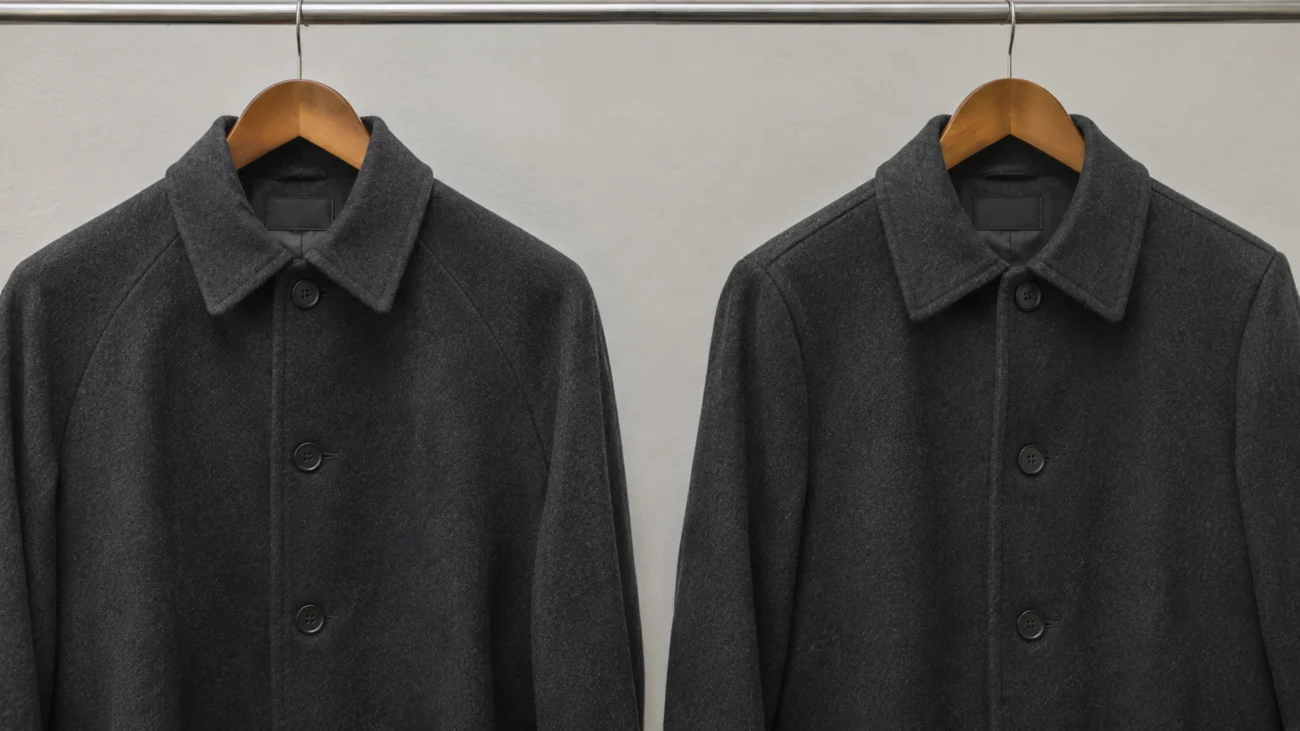
Start where the coat sleeve meets the collar, or where you expected it to. On a raglan coat a sleeve panel reaches the neckline. On a set-in coat the sleeve joins the body around the armhole, leaving a shoulder area between the sleeve and the collar. Choose the line you like by tracing those routes on two actual coats. A photograph of the preferred front and back gives the maker a much clearer brief than the word “soft.”
Featured image generated with AI.
Run a finger along the join
Take two coats in roughly the same colour and put them on hangers pointing the same way. Find the neck end of the first visible diagonal seam. Does it disappear under the collar? Follow it down towards the underarm. Look at the other side to see whether a pocket opening, a decorative line of stitches or a fold might have been fooling your eye. On a raglan front, the seam marks the edge of the sleeve itself.
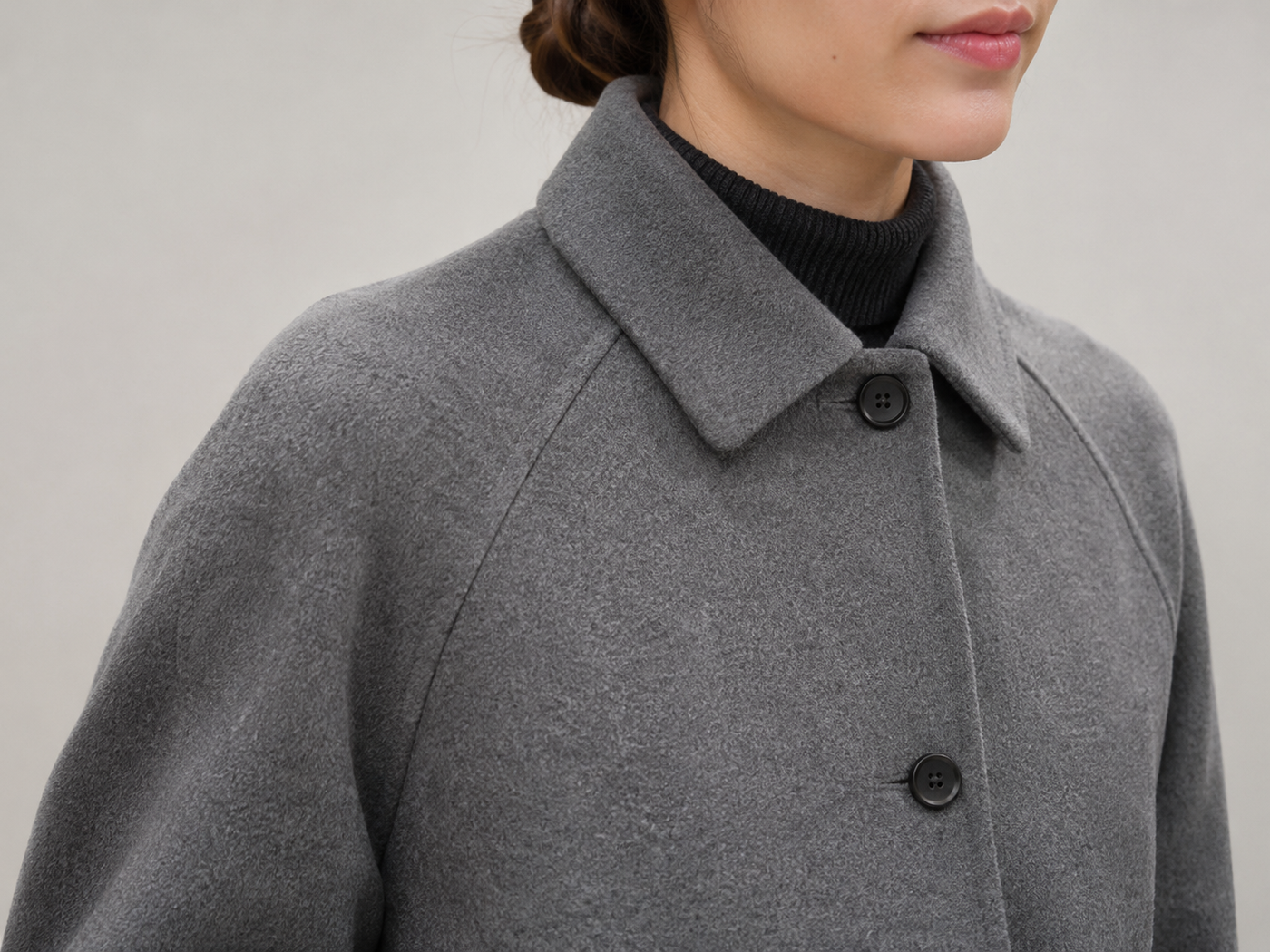
Turn the coat around and trace the back too. A design can use a different arrangement at the front and the back. Ask a cutter to identify a hybrid if the rear line takes a different route. Record what it does on each side. You can order a particular line even if you and the maker initially use different names for it. Mood’s sewing glossary is a useful reference for sleeve vocabulary when you compare notes.
On the set-in sample, find the top of the sleeve where it joins the body. Follow that armhole seam downwards and then locate the shoulder seam running out from the collar. On some coats the place where the seams meet makes a definite point of light. On others, especially in dark cloth, it nearly disappears. To see the construction, take the coat into daylight. To decide whether you enjoy the line, take it back into the light in which you normally wear it.
What can you see with the arms down?
Try the coats over the same clothes and close them as you usually would. Start with your arms hanging loosely. Look at the area between your collar and the outer edge of one upper arm. Is there a long diagonal carrying your eye away from the neck, or a short journey along the shoulder followed by a turn down the sleeve? There is no obligation to prefer the more obvious seam. A quiet one can give a textured wool plenty of room to be the main event.
Step round for a three-quarter view. A diagonal that almost vanished from the front might be the first thing you see from the side. Ask someone to take two pictures from the same chair and height. Keep your scarf off for these, then put it on for a third view if you wear one often. You may discover that the neckline end of your preferred seam will be covered for most of the winter.
The armhole name alone tells you very little about reaching the overhead rail on a train. If movement is part of the commission, demonstrate it in a sample. The photographer’s comparison of field-jacket backs shows how to isolate the extra cloth supplied elsewhere in a coat. You can prefer a set-in shoulder line and still ask separately what allows your arms to come forward.
Give each view a small sketch
Draw the collar as a short curve and the upper arm as a vertical line. Between them put the join you actually traced. On the back sketch, add a dotted line only where the seam disappeared under a collar or another layer. The cutter can fill in that small uncertainty. Beside the two views, write one difference you could pick out across the room, perhaps “the diagonal stays visible above my scarf on the darker coat.”
Bring those sketches and the sample reference to the order. Ask the maker to show you where the corresponding seam will emerge on the intended cloth. If the workshop sample has a different collar, mark the point again with that collar in place. The useful final card names the construction, shows the line you want at rest and gives the cutter an answer to one precise question. Where should the eye pick that line up when the coat is fastened?

One thought on “Which Shoulder Line Do You Want on Your Coat?”