

Pause on the pocket. You can describe its shape as soon as the film gives you a clear view. To name the person who made the jacket, you need a record that connects a maker to that garment. Start with the production credit, then look for a costume-department account or a collection entry that identifies the object. If the connection runs out, keep the maker open and take the pocket shape with you.
Featured image generated with AI.
An attribution note and a styling note can fit on opposite sides of a card. On one side you will write what the evidence supports about a particular production. On the other you will write what you would like to try in a jacket of your own. Keeping both gives you a useful result even when a well-documented film has very little to say about the shirt or jacket in your favourite scene.
Locate a jacket someone else could find
Open an authorised copy and identify the film, release or edition, character and scene. Add a time reference for the copy you watched and a short description of the action. “When the visitor hangs the keys beside the door” travels better between editions than an isolated time code. Note whether the garment belongs to the principal performer in a clear shot, to a distant figure or to a publicity image outside the film.
Wait for the camera to show the detail in more than one position. A patch pocket lies on the surface of the jacket. Its outline may be easy to follow when the wearer turns into the light and almost disappear when an arm crosses it. Trace the outside line on your own sketch. Mark the edge you cannot see with a broken pencil line. It is better to carry one open question than to turn an unseen corner into a design feature.
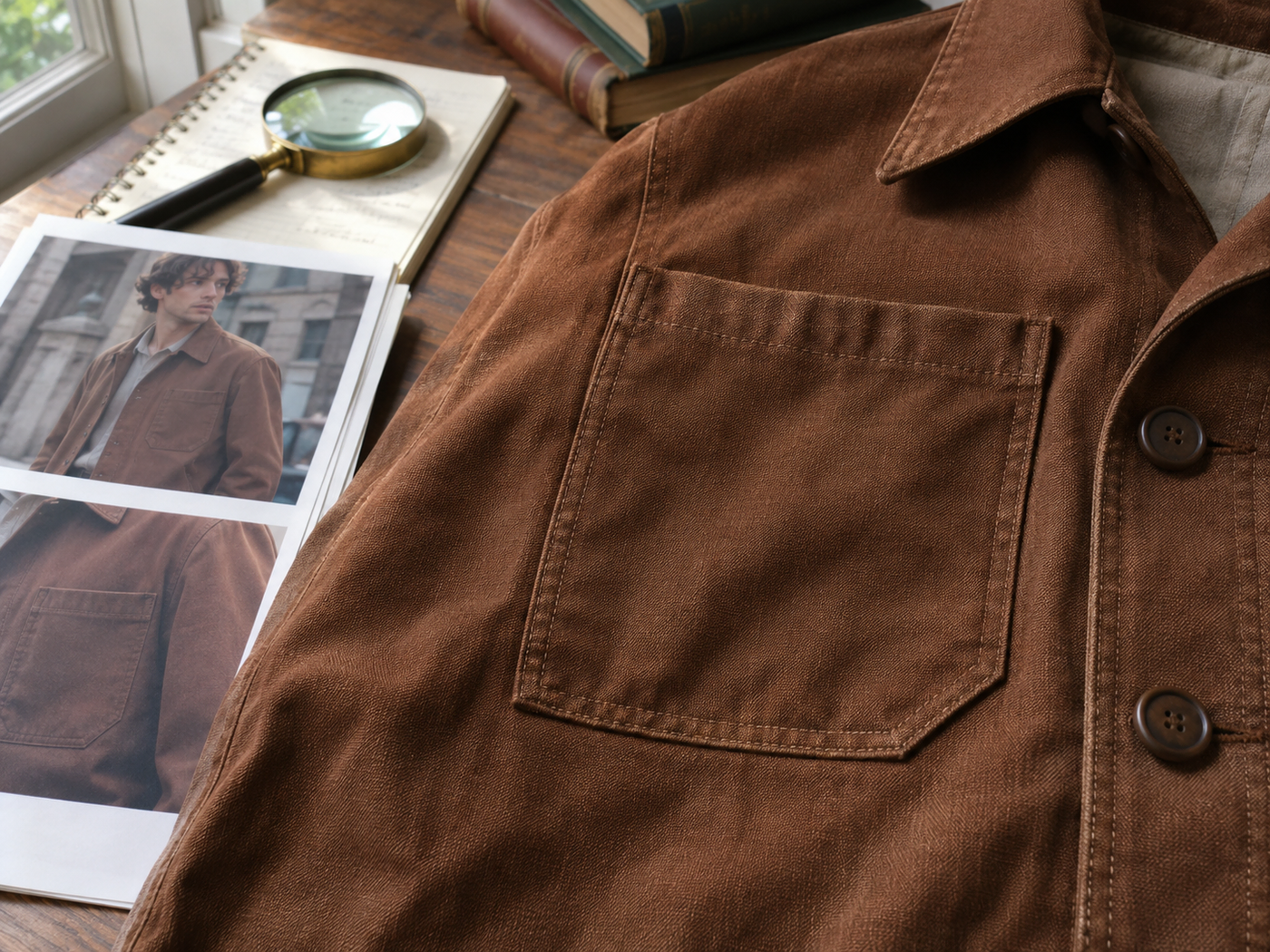
In our invented example, a chestnut work jacket has a broad chest pocket with one lower corner clipped on a diagonal. That single cut is the feature of interest. Colour may shift between a warm interior and an exterior shot, and the film might never show the pocket from the inside. Put “patch pocket with clipped lower corner” on the visible-detail side of your card. Leave material, maker and method of attachment for the documentary side.
Give each credit the scope it actually has
Read the film’s own credits, looking for the department and the exact wording beside a name. Costume designer, costume maker, wardrobe supplier and an acknowledgement of assistance describe different relationships. ScreenSkills’ description of costume work distinguishes designing and sourcing from making garments to a specification. It is entirely possible to establish responsibility for the production’s costume design while the maker of an individual article remains unidentified. ScreenSkills’ costume department roles
Copy the credited role accurately and attach it to the film. If several people are credited, preserve the distinction between principal cast, additional costumes and any character named in the credit. A company supplying clothes for a production might have supplied just one category or a small number of pieces. The fact that it appears in the end crawl gives you a place to look for a more specific statement.
Find material issued by the production, a named practitioner or an archive holding the costume. An interview can be especially valuable when the speaker describes the exact fitting, object or commission. Record who spoke, their role, the publication or recording and what they actually connected to the jacket. A designer discussing the colour of an entire film has given you different evidence from a cutter identifying a particular pocket on a particular garment.
Follow a record down to the object
A museum entry can answer questions that a production credit leaves open. The Smithsonian’s National Museum of American History identifies its jacket numbered 1989.0323.01 as worn by Harrison Ford in Indiana Jones and the Last Crusade. Its record distinguishes Peter Botwright as maker and Deborah Nadoolman Landis as designer of the original jacket, among the named relationships. That is a claim about an identified object with a specific film association. Keep the number and the film attached to the names. Smithsonian jacket record

Read all the way through the entry. An object named after a character could be a screen costume, a later reproduction, a promotional display or a design drawing. Look for a clear statement about use, provenance and which production the record covers. A donor’s name in a credit line identifies the gift. It may be somebody other than the person who designed, made or wore the piece. Transcribe each role under its own heading.
Even when an entry identifies a screen-worn object, a particular frame may show another copy. Costume departments can use multiples. If a museum connects a jacket to the actor and film but never singles out the frame you have chosen, preserve that limit. Write “museum identifies this surviving jacket from the film” and explain which visible feature resembles the one in your scene. Claim the exact take only with evidence for that further connection. For an exhibition photograph, check what the museum mannequin adds to the silhouette before attributing a particular outline to the jacket.
If a listing describes a replica, examine the difference between screen-worn and replica descriptions before using it as evidence. A well-made replica might be an excellent aid to seeing a shape while offering no primary evidence about who made the original. The right question is what the record can establish, and for which object.
Deal with a promising but incomplete match
Suppose a workshop archive contains a photograph of three chestnut jackets made for the same imaginary production. A notebook names the workshop and identifies the character. One jacket in the photograph seems to have a clipped pocket. The camera angle hides its lower edge. You can now credit the workshop with the jackets its record identifies. You still lack a clear connection between that particular construction and the garment shown in your selected close-up.
Write down what would resolve the question. Perhaps a labelled front view confirms the unusual corner, or a maker describes the pocket in a recorded interview. Search specifically for that evidence. Three fan pages repeating the same unsourced sentence will bring you back to the same point. When no firmer evidence turns up, date the note and move the visible description to the top. You can revisit the attribution if a catalogue is updated.
Check permission before making a still public. Viewing a film, keeping private notes and obtaining permission to reproduce a frame are separate matters. Use your own outline or a clearly labelled neutral recreation when a shareable view is unavailable. Keep a reference to the original scene so the next reader can find the detail in an authorised copy. The illustrations on this page depict an invented jacket.
Take the pocket out of the film
Lay two everyday jackets next to one another. On the first, a square patch forms a level base. On the second, the lower corner cuts in on a diagonal. Step back until the garment occupies roughly the same part of your field of view as the original character. Which jacket preserves the single detail you liked? Consider the pocket in relation to the whole chest. A finely copied corner on a much smaller pocket can lose its effect.

If you want a maker to consider the detail, sketch the visible perimeter on a front view of your own jacket. Indicate which corner is clipped from the wearer’s perspective. Ask the maker how the pocket could function in the fabric you intend to use. Keep a reproduction claim off the order. What you are commissioning is a pocket whose outline you can describe and whose use suits your life.
Sometimes your interest changes when you revisit the sequence. The thing you remembered as an unusual cut might actually be the way the wearer starts fastening the jacket after taking on a new role. Then compare the character’s clothing across three scenes. That approach can identify an expressive habit while leaving the garment’s authorship exactly where the records place it.
Finish both sides of the card
On the evidence side, enter the film and scene, credited role, strongest object-level source and what remains unresolved. Keep the date you checked the record so a later catalogue revision can be traced. A short final sentence could read, “The film credits its costume designer. No record consulted identifies the maker of the clipped-pocket jacket in this scene.”
On the wearable side write, “Broad chest pocket, one lower outside corner cut on a diagonal. Compare it with a square pocket on my own brown overshirt at conversation distance.” One side is ready for a researcher to check. The other is ready to take to a worktable. You can put the second to use immediately.