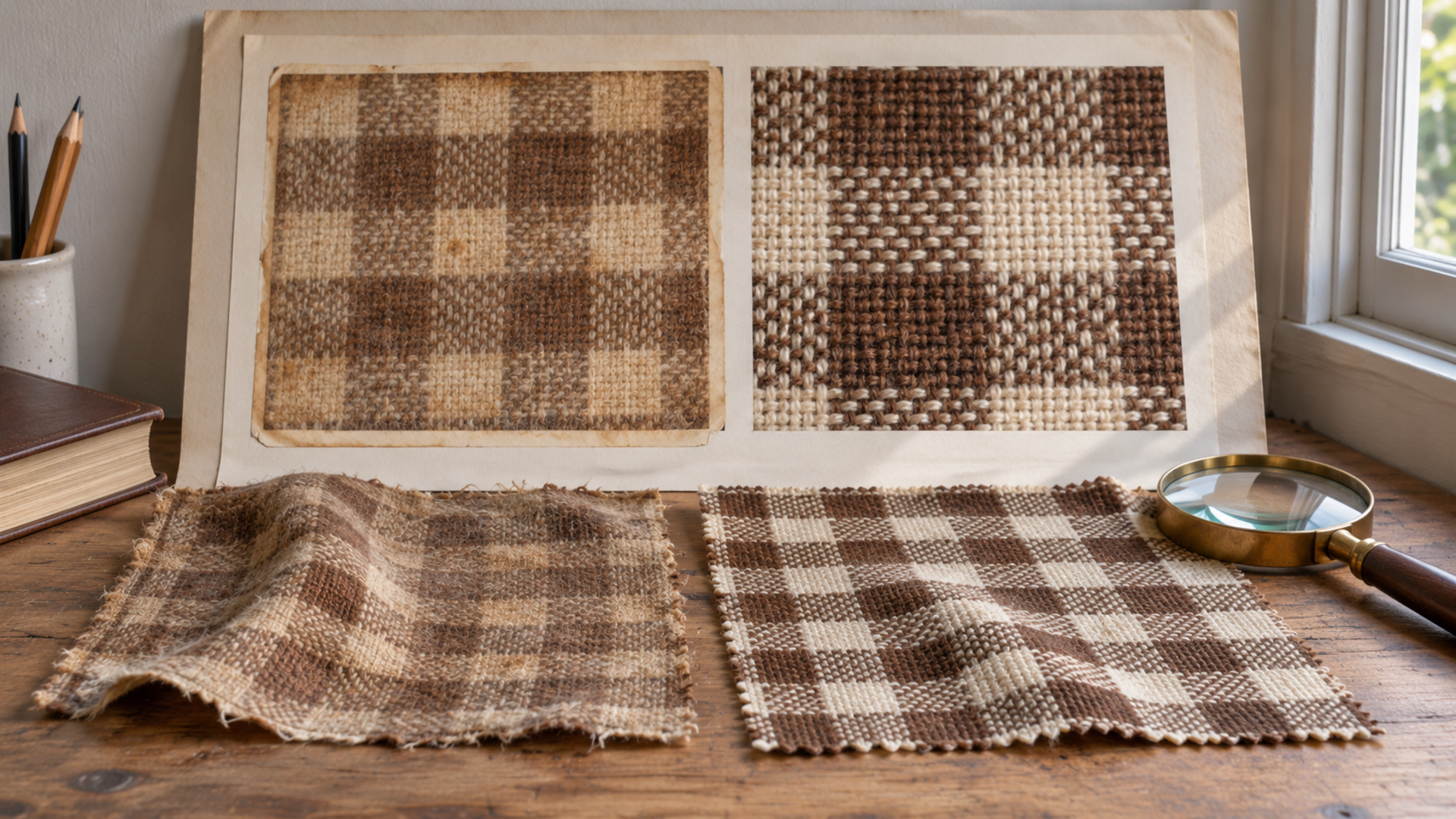
Circle the smallest shape that makes you want this cloth. Perhaps a dark check ends in two little teeth, or four pale squares sit together between heavier bars. Give a merchant a view of that detail, a second view showing a whole repeat and a sense of scale. Add a possible pattern name only after you have described what repeats. The merchant can then offer useful swatches even if the first name you tried was wrong.
Featured image generated with AI.
A crop of an admired jacket can suggest a family of designs. It seldom tells you exactly how the original cloth was woven, who made it or which current fabric is identical. A good enquiry leaves enough room to discover a close alternative. The object is to recognise what you liked when a cutting arrives on your table.
Keep more than the prettiest square
Start with the largest authorised view you have. Find a relatively flat part of the garment with several repetitions, away from pocket openings, turned edges and deep shadows. A sleeve curved towards the camera can make a regular check look narrow at one side. A folded lapel can bring two directions together in a way that looks like part of the motif. Save the whole image with the detail crop so you can relocate it later.
Choose a patch where you can follow the pattern sideways and up or down. Imagine cutting a small rectangle out of the picture and making copies of it. Could you cover the rest of the patch by sliding those copies along? If adjoining edges do not agree, enlarge the rectangle to include the next line, colour or change of direction. For a staggered motif, you may need another row to return to the same starting position.
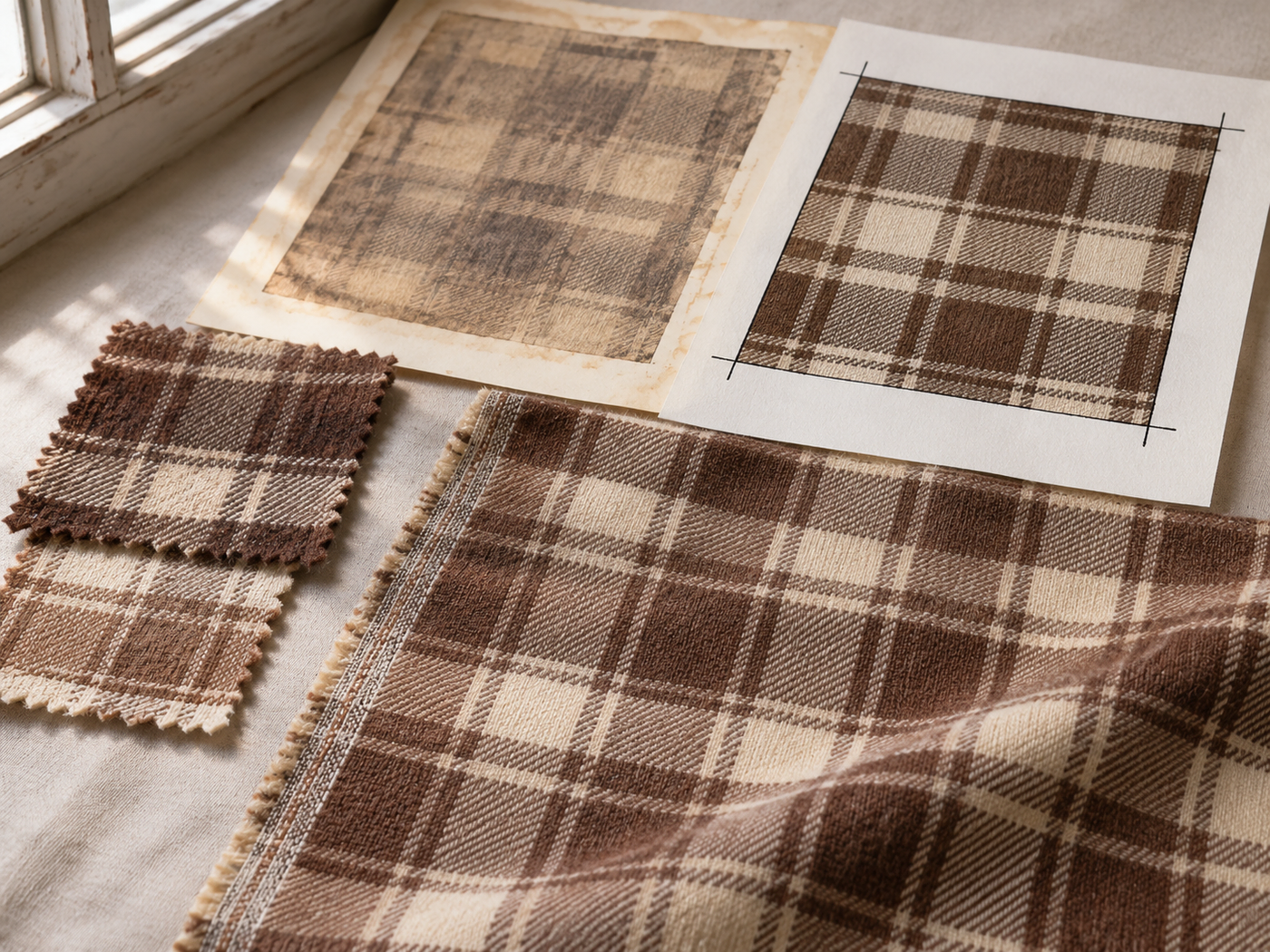
If the only source is a thumbnail, try describing it at the size at which you actually saw it. You may be drawn to a fine flicker of dark and light that reads almost as a solid from several steps away. Record that first. A larger file could later reveal a broken check, but the fine, quiet effect is already a real preference. Ask for candidates that preserve it at normal viewing distance.
Draw one journey across the repeat
Use squared paper or a blank index card. Put a dot on a memorable spot, perhaps the near corner of a pale block. Travel to the right until you reach the next spot with the same neighbours. Count the changes you pass. Now go down from the first dot and repeat the exercise. Draw the simplest outline that honours both journeys. A few uneven pencil marks can communicate more than an elaborate textile name.
Separate the outline from its contents. Is the outside square, stepped, jagged or curving? Is the centre solid, striped or filled with smaller checks? Do alternating blocks reverse the dark and light? Does another coloured line travel through several small repeats before it returns? Treat that larger rhythm as another layer of the description. A cutting showing a single small block may miss the feature you really want.
Put an arrow on the sketch to show how the motif appeared on the garment. If one diagonal climbs to the left and one to the right, draw both. A photographed cloth held upside down can look like a new pattern until you turn the sheet. Keep the reference direction even when you have no way to know which way the piece lay on the original roll.
Compare families on the same scale
Take an imagined pair of brown and cream checks. From across a counter both seem to be small brown squares on a light ground. Look closer at the first. Each dark block has clean straight borders and the crossings are orderly. In the second, little projections interrupt two edges of the dark area and neighbouring light shapes fit into the gaps. “Small brown check” describes both. “Small broken check with two projections on the dark shape” gives the merchant a reason to pull the second one.
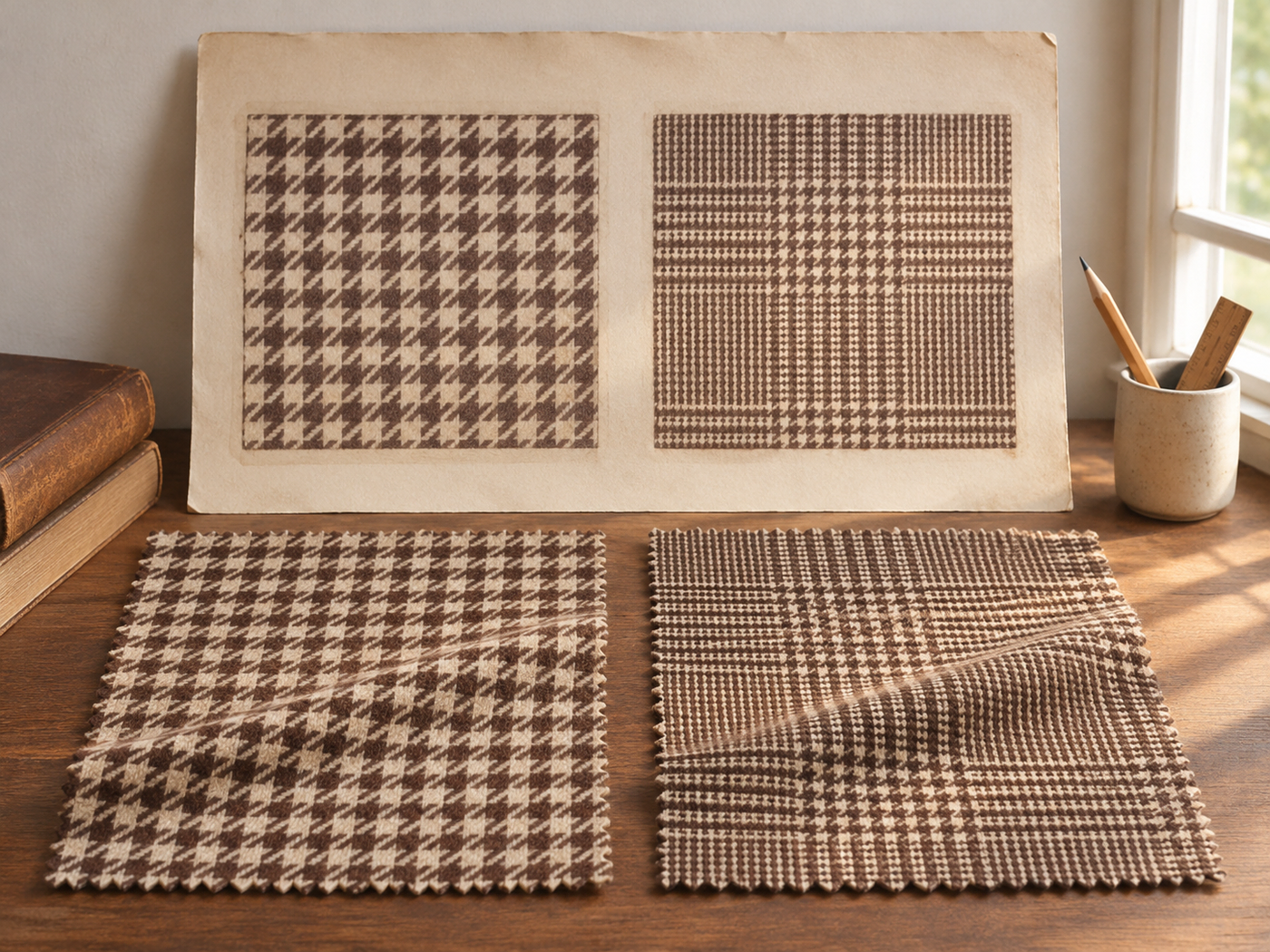
The Dress and Textile Specialists’ teaching guide illustrates houndstooth as a check with a jagged edge and contrasts it with gingham. Use its examples to practise looking for the shape of the boundary. If your crop resembles the broken example, “houndstooth family, possibly” is a reasonable working description. A name attached to a different, well-documented specimen cannot establish the exact weave of the cloth in your picture. Dress and Textile Specialists’ weave examples
Put both candidates at the same apparent scale. A blown-up telephone image beside an actual cuff can turn a very fine pattern into something graphic and bold. If you own the source cloth, measure between two corresponding points across several repeats and divide by the number of intervals. Write down which two points you used. Counting the starting point as an interval will throw the estimate off.
If the garment belongs to somebody else and there is no measured reference, resist converting a nearby button into an exact ruler. You do not know its diameter or whether it is in the same plane. Give relative scale instead. Say how many repeats appear across the visible pocket, how large the pocket looks in the whole photograph and which part of the photograph is uncertain. Ask for two candidate sizes you can judge on actual cloth.
Make the missing information useful
Describe what is known separately from what you hope a merchant can clarify. You can see recurring diagonal marks without knowing whether they come from coloured yarns, a printed surface or the way light catches the cloth. If the image looks obviously different when rotated or resized on a screen, note that too. Ask for a physical cutting before committing to a length for a jacket.
A second colour can be particularly elusive. Suppose the original looks like rust over grey-green in the daylight photograph and brown over tan in an indoor copy. Send the better source with permission and describe both readings. Tell the merchant whether the warm accent or the cool ground is more important. Offering permission to vary one of those qualities gives the search somewhere to go when the original colours cannot be recovered.
A label or woven edge may lead to firmer information about identity. Follow that lead separately with the guide to reading a cloth’s woven edge. If the uncertainty concerns a painted or illustrated source, a painted brocade reference calls for particular care over which marks belong to the depicted cloth and which to the artist’s rendering.
Put the merchant’s cuttings through one test
Lay the candidates in a row with the crop at one end. Cover the labels for a moment. Which cutting preserves the shape you circled before you knew a name? Eliminate one that fails the feature you care about, even if its label matches your original guess. Now stand back to your usual viewing distance. A cutting might win on the table and lose once the little teeth dissolve into a plain field.
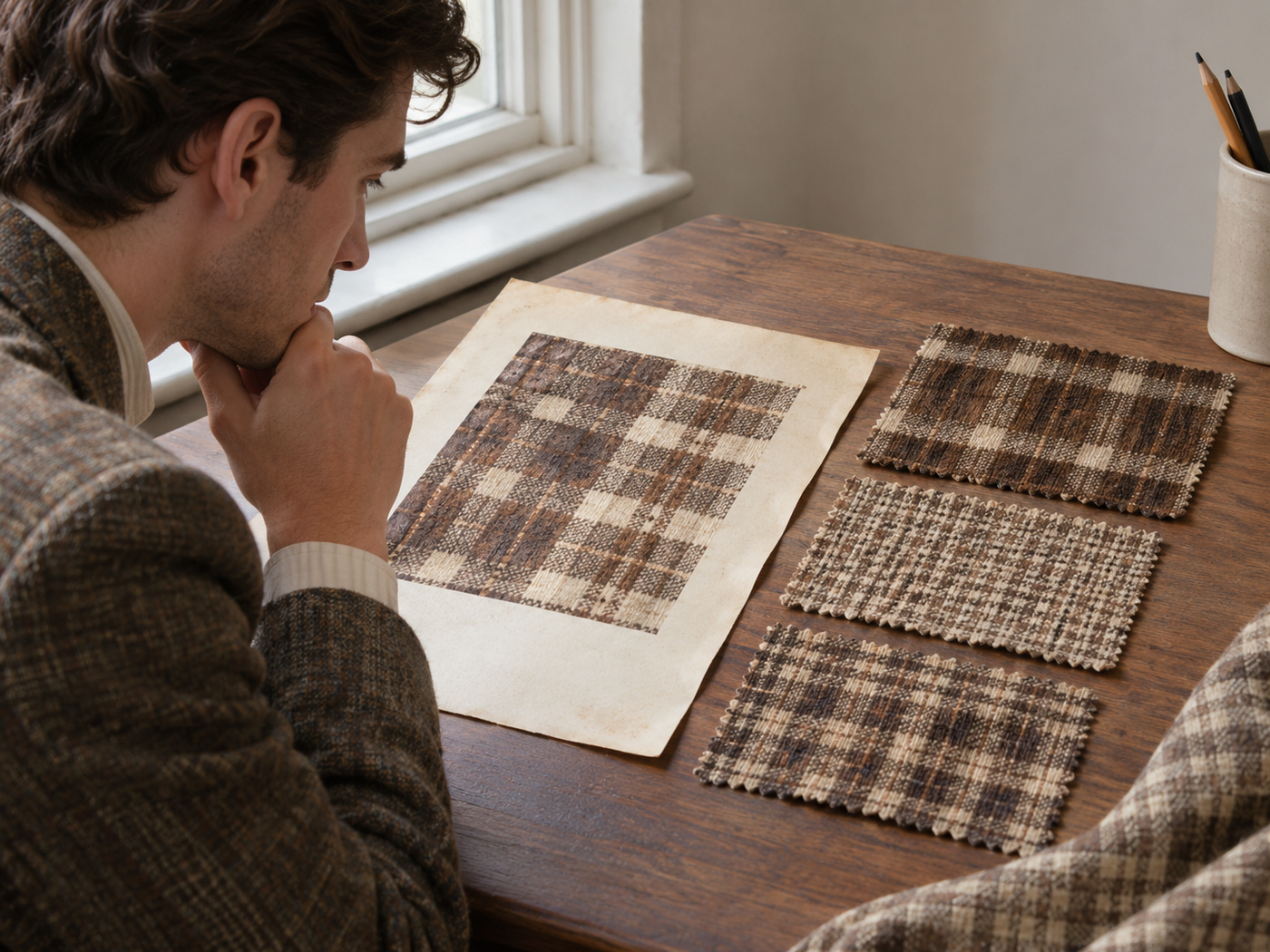
If you need a larger piece to see the repeat, say how much of the pattern is missing from the supplied cutting. Ask for a photograph of the full width with a ruler in the plane of the cloth, or to see a hanging length in person. Check whether more samples are available and what the merchant charges. There is little point buying two more small squares if the open question is how often a broad coloured bar returns.
Write your final preference in terms another person can check. For example, “Keep the stepped dark edge and the narrow pale channel between blocks. Either brown or charcoal works. In my reference, the small shapes nearly merge when seen from the other side of a desk.” Ask the merchant to label the suggested cuttings with their own design names and references. You can then ask for the same one again without relying on your first guess.
A swatch enquiry ready to adapt
“I’m looking for a small two-colour check for an overshirt. I’ve marked one full repeat in the attached crop and drawn the dark block at a larger size. Its corners break into little teeth, with a plain pale space between the blocks. Houndstooth is my working term. I cannot tell the weave or the original dimensions from the photograph.”
“Could you send one fine and one slightly larger candidate, each with a reference and an indication of the actual repeat? Please keep the broken edge if the precise colours are unavailable. I’d like to compare the full motif and the view at arm’s length before deciding.”
Save the sketch beside the selected cutting. Underline the part of the enquiry that actually helped distinguish it. The next time a fabric catches your eye you will have a vocabulary built from something you can hold, a name a merchant recognises and a clear record of where the visual comparison ends.