

Choose the few words the wearer most wants to carry, ask the writer or family for permission and have the embroiderer sew a trial from a copy. Approve the handwriting at its finished size before it touches the wedding garment. An interior patch can be moved if the owner wants that option. A dedication worked into a lining asks for a different commitment from the garment’s owner and maker.
Featured image generated with AI.
Begin with the gesture that makes the writing recognisable. It might be the open loop on a capital L, a tail that runs under the next word or a little gap where the pen always lifted. Circle that feature on a copy. The best test of a sewn sample is whether the person who knows the hand can still find it when the letters are only a few millimetres high.
Decide whose words may travel
Ask the wearer what memory they want the garment to hold. A line from a shopping list might carry more of a parent than a formal signature on a certificate. A short greeting can fit inside a jacket without reducing each letter to a speck. Lay out two possible extracts, read them aloud and let the wearer choose which words still have their meaning once separated from the rest of the page.
Ask the person who wrote the note if that is possible. If it belongs to a family member, ask the owner about making a copy and sharing the chosen extract with an embroiderer. The rest of the paper might contain an address, a private message or the names of people who have no part in the commission. Make the work file from the agreed passage and keep the full page within the family.
Discuss separately who may see the result. A wearer might happily show a partner while getting dressed and prefer the photographer to keep it out of a public album. Another family may want a detail photograph for relatives who cannot attend. Agree on that audience before a supplier puts the finished work in a portfolio. Permission to sew the words and permission to publish the family’s story answer different questions.
Keep the original safe and legible
The US National Archives recommends retaining original family papers after digitising them and taking care to support them during capture. It advises against feeding fragile or valuable papers through an automatic scanner. A flat page that fits a scanner and a delicate bound letterbook call for different handling. If the note resists opening, ask for help making a safe copy rather than forcing a fold flat. US National Archives’ guide to digitising family papers
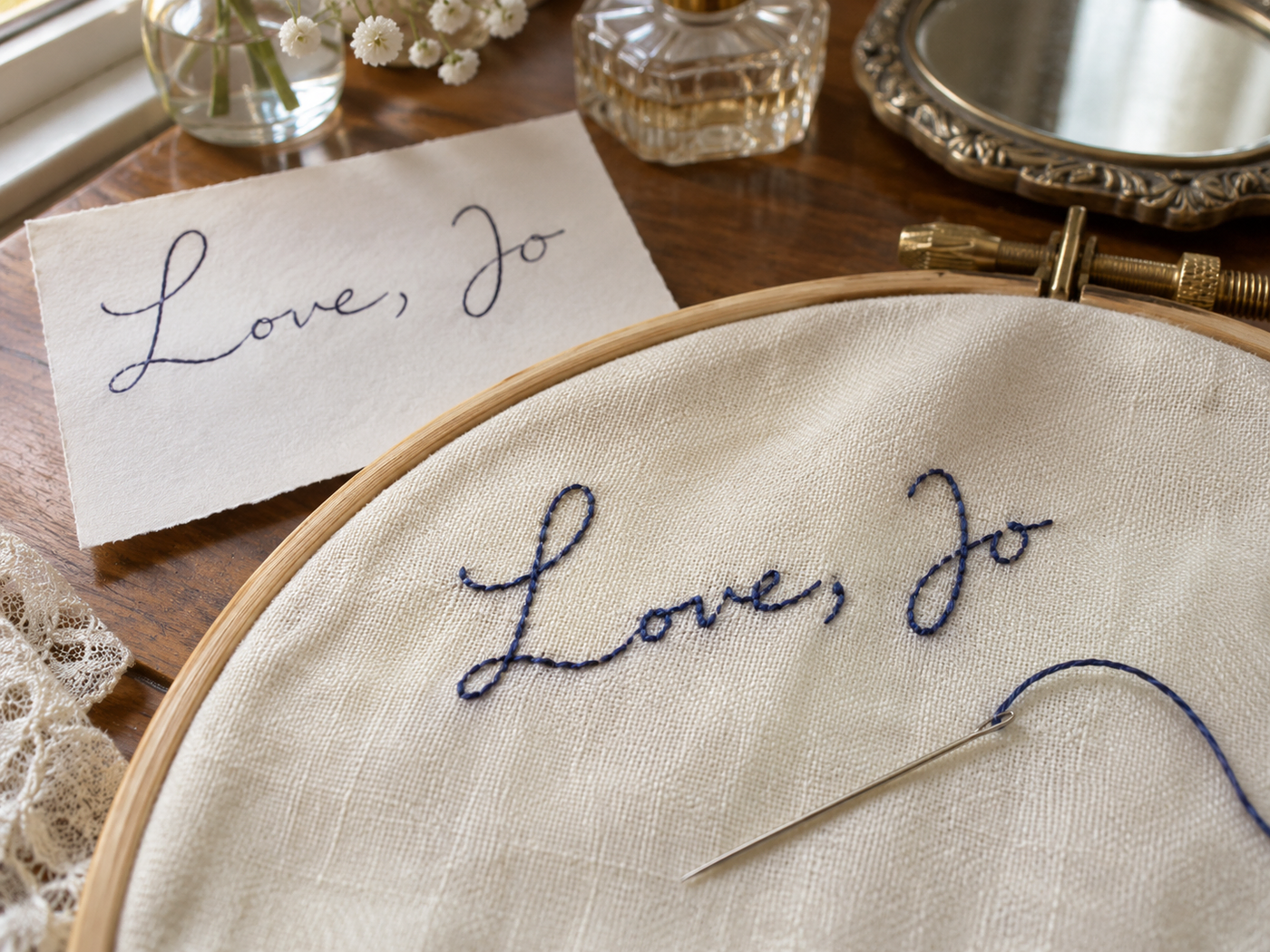
Use a clear copy that includes the whole chosen stroke, including its beginning and the little finish beyond the final letter. Take one view that preserves the original proportions and a closer view of the feature the wearer treasures. Tell the maker which copy represents the full extract. A phone crop can make a small descending loop appear to be a loose mark from the line below.
If the ink has faded, provide the best unaltered copy you can alongside any marked working copy. Circle the important shape on the copy, taking care to keep your pencil clear of the letters the embroiderer will trace. If part of a stroke is missing in a crease, ask whether the wearer wants the gap preserved or the maker to propose a repair on paper. Have the family approve any reconstruction before sewing it.
Let the thread keep one particular movement
Imagine an invented note ending “Love, Jo”. In the capital L, the pen rises into a narrow loop and sweeps down into a long low curve. The J ends with a small flourish. A typesetter could find a pleasant script that spelled exactly the same words and still lose both gestures. Ask the embroiderer to use the actual writing as the reference and point to the loop and flourish on the working copy.
Ask what happens between that copy and the first stitch. The maker might trace the writing by hand or prepare a stitch file for a machine. Ask what scale the process can hold in the selected cloth and thread. Narrow spaces can close as the thread turns a tight corner. A short proof of the distinctive stroke may answer an early question, but approve a full extract before the final placement is fixed.
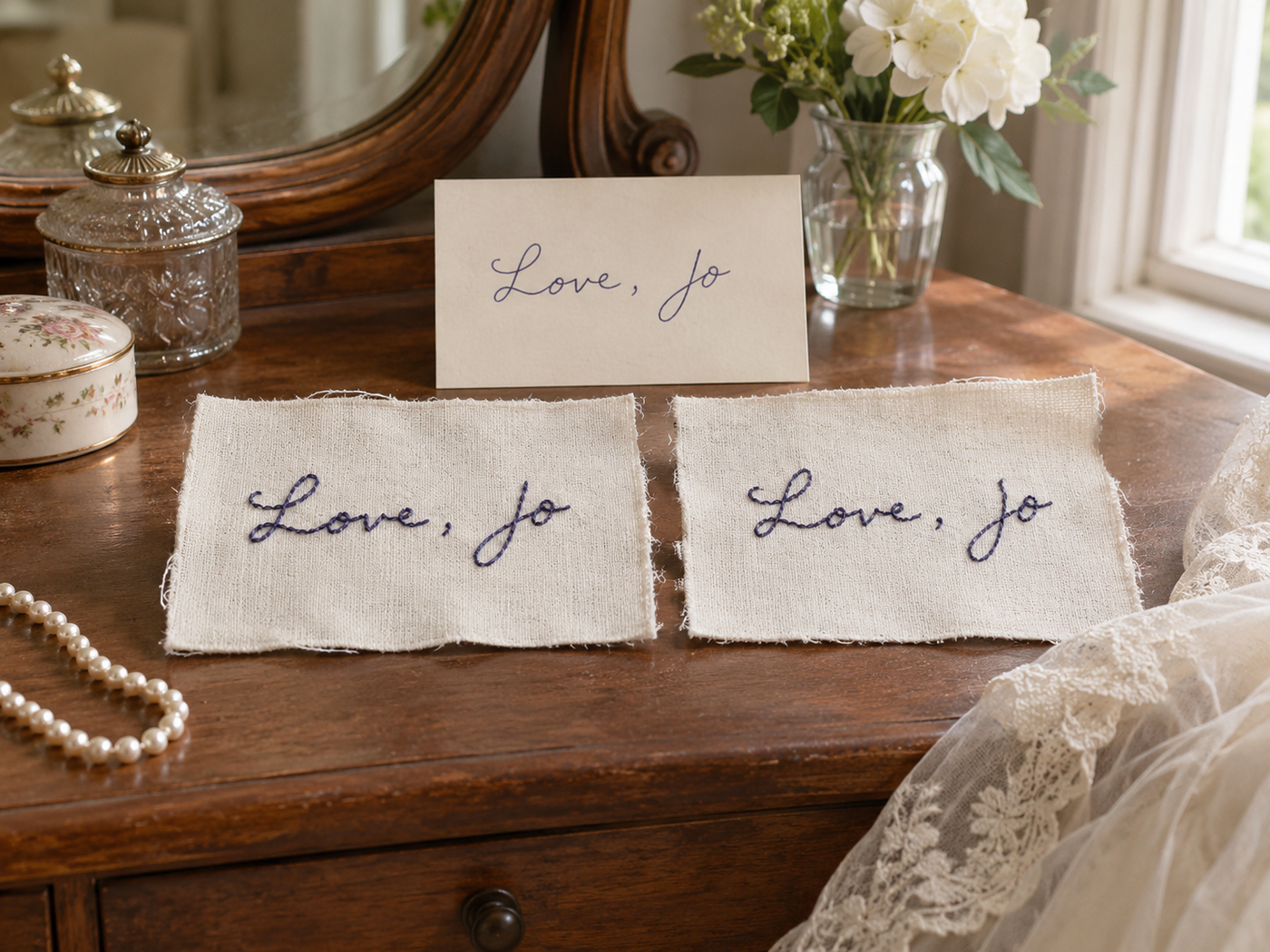
Put two sew-outs beside the copy. One might use a finer line that keeps the loop open but nearly disappears against the lining. Another might be easier to see yet join two pen strokes the writer kept separate. First look from the distance at which the wearer will see the dedication when opening the garment. Then examine it close up. Name the smallest revision that will protect the recognisable gesture, such as keeping more space inside the L.
Ask a second family member to read the sample without prompting if the writer and wearer are comfortable with that. A useful response is “I knew that was her L before I read the rest”. If they hesitate over a word, check whether the difficulty already exists in the original. The aim may be to keep a private, rather untidy signature exactly as the family remembers it. Legibility to strangers need not decide a dedication meant for one person.
Choose a place the garment can accept
Open the jacket or other wedding garment as the wearer would when putting it on. Hold a paper piece the size of the proposed embroidery against the interior. Check which way up the writing appears to the wearer and to someone facing them. A patch that reads upright on a coat hanger can sit upside down from the wearer’s point of view. Mark the neckline direction on the placement sketch. For a shirt, test the placement of the initials with the cuff fastened so the wearer can see who will be able to read them.
Consider the structure behind the proposed spot. A pocket opening, seam, lining fold or area of frequent friction may compete with the patch. Ask the tailor or garment maker to identify an available area and explain how the attachment would show on the outside. Keep the sewn proof against the actual lining when making the choice. A dark ground beneath pale cloth can change the way fine lettering reads.
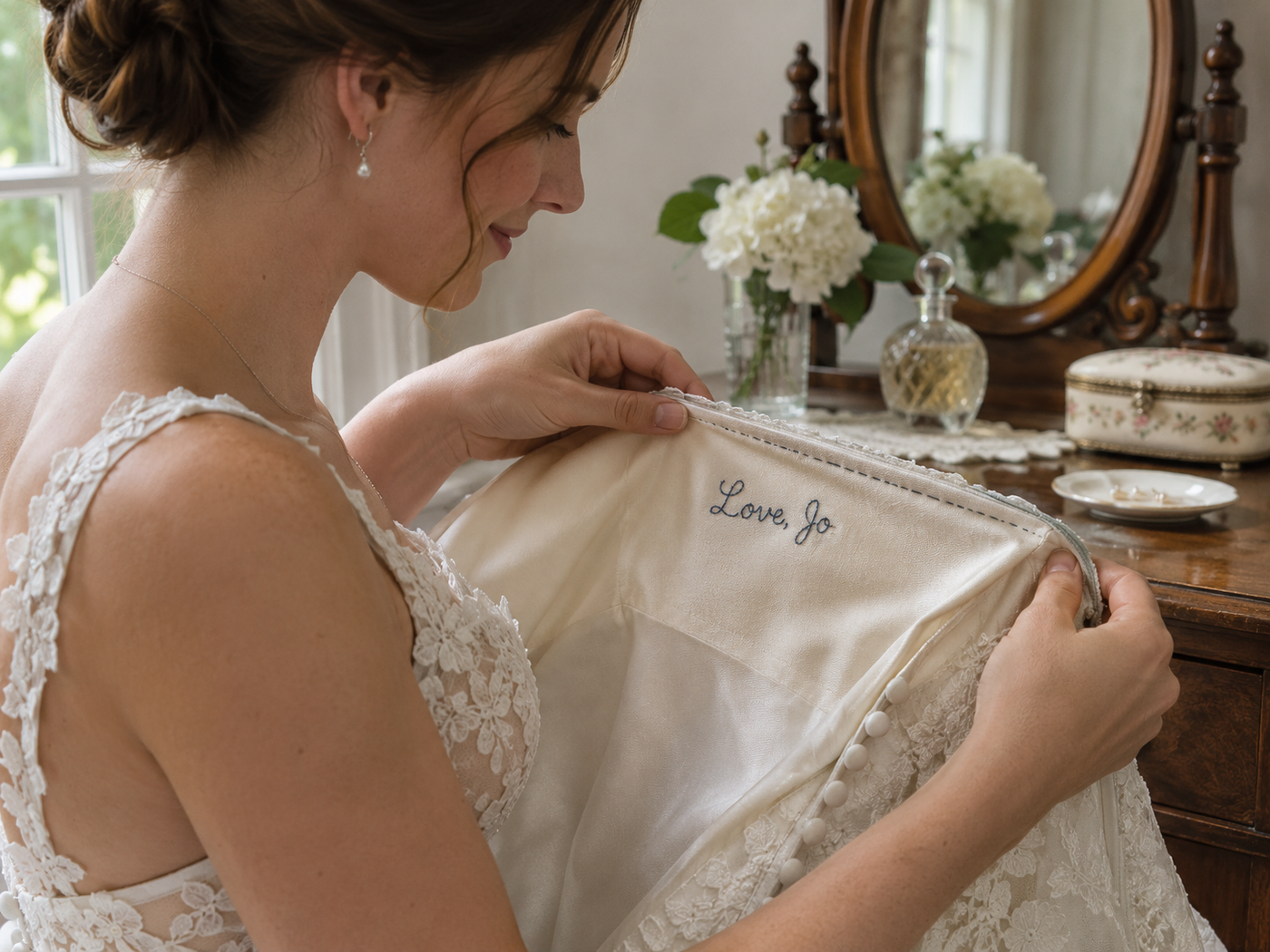
If the garment is borrowed, hired or inherited, ask the owner before planning any attachment. A removable patch still needs an approved way to attach and remove it. If the owner wants the garment completely intact, consider a separate piece that can be carried or displayed with permission. For a delicate family garment, decide whether the heirloom can be worn before commissioning work that depends on its use.
Compare a separate patch with a dedicated lining
For a patch, ask who supplies the ground cloth, finishes its edges and attaches it. Ask whether the maker can detach it later and what the garment would look like afterward. That option can appeal to someone who hopes to move the dedication into another piece after the wedding. The edges of the patch become part of what the wearer will see, so include them in the size proof.
For embroidery in a bespoke lining, bring the embroiderer and the person assembling the garment into the same decision. Ask at which stage the lining must be worked, who will mark its final position and whether any letters could disappear into a seam or turn. Ask how the maker would handle replacement of the lining in the future. A permanent decision can be welcome when its consequences are understood by everyone who owns or works on the garment.
Request an actual written quote for each feasible route. Record location and currency, preparation of the handwriting, the sew-out, revisions, materials, attachment and any separate garment work. Note the date by which the maker needs approval. Two quotes labelled “embroidery” can cover different jobs if one ends with a loose patch and the other includes installation in a finished jacket. Agree the work first and compare the same list of services.
Approve the dedication and its first viewing
Write the exact words beside the approved stitched proof. Include the identified source copy, finished width and height, thread and ground, orientation and the marked position inside the garment. Have the wearer and owner confirm placement. If a helper must receive or open the garment during the ceremony, agree the handoff and who may see the interior with the people taking part.
One possible instruction is “Use the approved two-word sample with the open loop of the L. Attach the separate patch to the marked interior area, upright to the wearer as the jacket opens. The owner has agreed to the attachment shown; ask before making a change.” Keep a photograph of the approved sample with the family copy and agree what the embroiderer should retain.
Before the garment leaves the workroom, let the wearer open it in their own way. The question to take back to the family is a personal one. “When you see this stroke, do you recognise the person whose words you wanted to carry?”