
For a shift at a public desk, start with the uniform policy for that job and that location. Mark the pieces you must wear, the choices already open to you and any change someone still has to approve. Pick one personal detail from the second group, or take a specific request from the third to the policy owner. You can then get dressed for work without asking the same question every morning.
Featured image generated with AI.
A useful answer is small enough to act on. “The issued blue shirt with the approved grey cardigan on ordinary desk shifts” is such an answer. “People here dress fairly casually” is an observation you cannot put on an order or show to the person assigning you a formal reception. Make your own short options card from the employer’s actual instructions.
Get the version that goes with your shift
Ask the person assigning the uniform where current instructions live. Include your role, site and duty. A museum may have different arrangements at the admissions desk, in an education room and at a donor event. A library may distinguish a public service shift from work in a closed collection. Your normal uniform might be entirely appropriate at one counter and incomplete at another.
Record the revision date if there is one and the office responsible for updates. A screenshot from the staff chat can preserve a useful answer while losing the date or scope. Ask for a link or copy you can consult when a manager changes. If the instruction is verbal, read it back with the relevant duty attached. A reply such as “yes, on ordinary desk shifts” gives you an important limit to put on the card.
Identify which pieces the employer issues and which it expects you to obtain. The issued shirt might be compulsory, or it might be one of two approved versions. Trousers bought by the wearer might still have a precise specification. Ownership alone does not tell you how much choice you have. Write the garment’s status in words beside the item rather than relying on which pile it came from.
Sort one real outfit into three groups
Use the top of a bed or a clean table. Put the items the policy requires together first. Next put out the alternatives it explicitly permits. Leave a separate place for a personal item you would like to add but cannot find in the instructions. Take a photograph for your own use if permitted, or write down the names. You now have a reasonable outfit to wear while the open question is being settled.

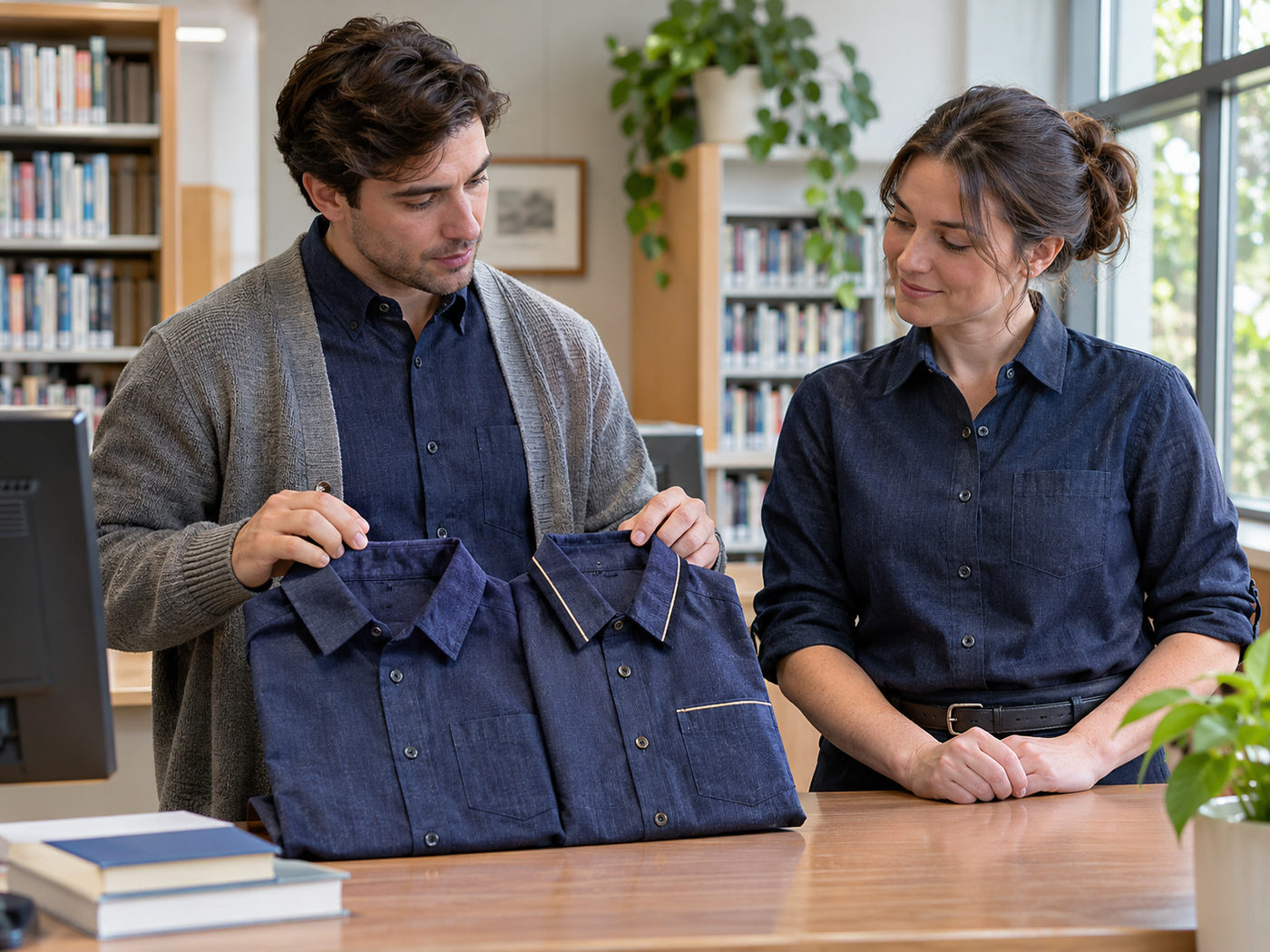
In a hypothetical museum, suppose the desk brief requires an issued indigo shirt and a visible staff identifier. It permits either of two named dark trouser cuts and an approved grey cardigan. The employee can choose the preferred cut and can wear the cardigan when the entrance is cold. A personally owned navy cardigan remains an unanswered question, even if it looks very close to the approved grey one. These are invented terms for the example.
For a real US example of how closely a policy can specify small details, the National Park Service’s uniform order identifies the ornaments approved for regular wear and sets out a written approval route for certain special commemorative pins. That is the service’s own rule. A museum, a hotel or a library needs to give its own answer about a pin. Read the section naming the item and the person who can approve it. National Park Service uniform order
Choose a change you can show in one view
Think first about the part of the shift you would like the choice to improve. Perhaps it is the temperature near the doors, the movement of a shirt when reaching for a map or the way an outer layer frames your face. Describe the change in observable terms. A neat photo or simple front drawing can show how an optional cardigan sits around a badge much better than “a bit more personal”.
Work within the choices already allowed before considering a special order. If the policy names two shirt styles, try each with the required identifier in place. If a layer may be worn open or closed, look at how the entire uniform reads in both states. The visible difference you enjoy can be very modest. Personal preference belongs in the choice between approved pieces even when an observer would struggle to say what changed.
A permanent alteration or a stitched name involves another decision. Ask who owns the item, whether changes may be made and what must happen when it is returned. If the question is how you will be identified by the public, agree the visible name on a service shirt through the relevant workplace process before asking anyone to embroider it. A permitted cardigan does not decide what can go on the shirt beneath it.
Take the request to someone who can answer
Bring the exact garment or a clear drawing and a copy of the policy passage. Ask, “May I wear this plain grey layer over the issued shirt for regular admissions shifts, with the identifier fully visible here?” If you want to buy something, add whether the answer depends on the model, colour, supplier or garment itself. It saves money to learn that “grey” means an issued model before ordering a close match elsewhere.
A supervisor may be able to interpret the everyday options while somebody in operations, uniform services or human resources authorises exceptions. Ask who owns the decision. If the issue concerns a personal adjustment handled through a confidential process, use the designated contact and share relevant details within that process. You can ask where to go without explaining the reason in a staff group or during a busy handover.
Get the answer in a form you can use. “Permitted for the weekday desk only, provided the ID stays visible” supplies a scope and a condition. “Looks good to me” from a colleague supplies an opinion. If a supervisor needs to see the piece in person, wear it with the rest of the outfit, including the identifier. A cropped picture of the cardigan cannot show the part the public needs to recognise.
Two colleagues, one clear public role
Imagine the museum’s two admissions staff on a winter morning. One wears the approved cardigan closed with the identifier in the specified visible position. The other prefers the issued shirt with its sleeves in the permitted state and the second approved trouser cut. From the visitor’s side of the counter both are easy to identify. The differences answer actual needs without requiring the manager to design two individual uniforms.

Now move the first employee from the entrance to a formal evening function. The daytime approval may have been tied to the desk. Check the event instructions before treating the cardigan as part of an evening outfit. If staff portraits will be made at the event, check which uniform detail the portrait should show. Permission to wear an identifier at work and permission to reproduce it in a public profile can be separate questions.
Suppose the museum changes the approved layer mid-season. Date the earlier entry and add the replacement with the effective shift or event. Ask what to do with an already purchased piece if the employer had authorised it. If a payment is involved, check which work clothing an allowance covers before presenting a receipt. A garment’s acceptability and its eligibility for reimbursement may be decided by different people.
Keep a card you could use on your first day back
- Write your role, location and ordinary shift at the top. Name the policy version or location and the manager or team responsible for the instructions.
- Under required, list the actual pieces and the placement of anything the public needs to see. Under permitted, list the choices you can make without asking again.
- Under awaiting approval, describe one proposed change, who will answer and what you will wear meanwhile. Move it to the permitted group only with the reply and its conditions.
Leave a little space for a duty that has different instructions. Perhaps the approved cardigan goes on the ordinary desk line while an event jacket goes on the evening line. If you work at two sites, use a separate line for each. A useful card helps the employee covering your shift as well. They can see which answer came from policy and which depends on a permission given to you personally.
Before the first shift in a new combination, stand where a visitor would stand if the workspace permits. Look at the whole outfit in ordinary light and test the work you actually do. Can the visitor identify you when you turn? Does the cardigan cover the badge when you sit down? The most productive last question for the supervisor is “Does this exact arrangement meet the instruction for this desk?” Once that is settled, the personal choice can become part of an ordinary working day.