

Hold a length of suiting with the woven edge facing you. Copy the words exactly, find the reference for the cloth in the supplier’s sample book and ask who can connect the two. The mark gives you a lead to an identity. A usable statement of origin comes from matching that particular length to records that say who supplied it, wove it or carried out another named stage.
Featured image generated with AI.
The finished lengthwise edge is the selvedge. You may see letters woven into it at intervals, a run of colour, a code or no words at all. The narrow edge holds very little text compared with the number of hands a cloth can pass through. Give each piece of information its own line. A buyer who records exactly what the edge says can ask a better question than one who begins with a confident story about a mill.
Read a complete stretch of the edge
Lay out enough cloth to see whether the wording repeats. Start at the beginning of a repeated phrase and follow it to the next occurrence. A name at the end of a cutting might continue at the start of the next repeat. Keep punctuation, spacing and numbers, and indicate where letters disappear into a cut or a frayed corner. Write “unreadable after the third letter” if that is all you can see.
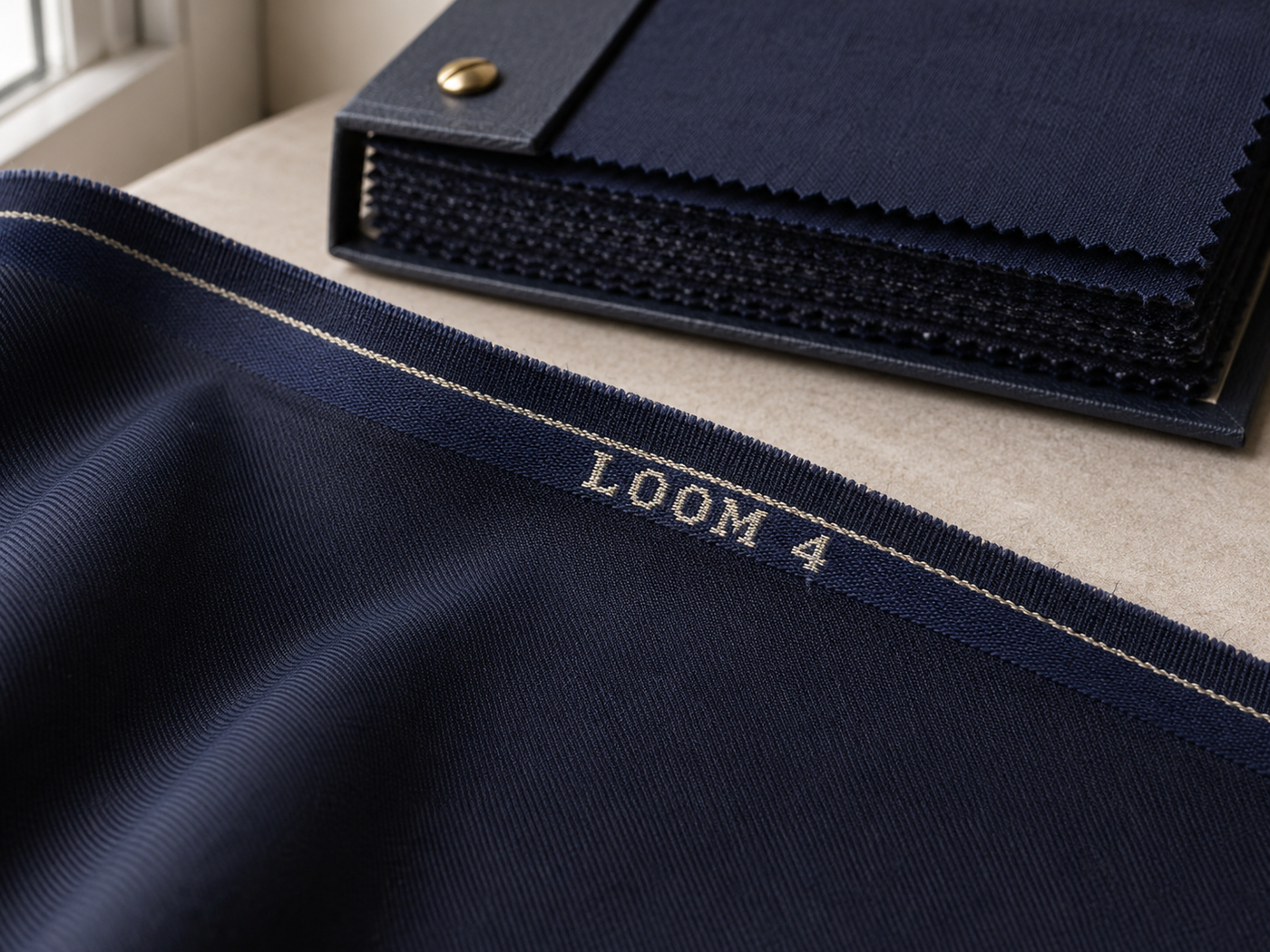
Look at the edge beside the face of the cloth. Under ordinary light, describe the face in plain language: dark blue with a fine pale stripe, for example, or a grey check with a smaller broken shape inside it. Note which face you are describing. That simple observation helps prevent a colleague from pairing the right transcription with an entirely different cutting. A second navy cloth can bear the same edge wording.
With the owner’s permission, take one view close enough to read the words and another showing how the edge relates to the whole length. Keep them together. If permission covers private ordering only, keep the images in your own order file. Ask separately before reproducing a supplier’s mark in public. The teaching images here use invented cloth references, so they can show the method without claiming to document a particular mill’s work.
Look for the individual cloth in the bunch
A bunch is a supplier’s collection of cloth samples fastened or bound together. The name on its cover can identify a family of fabrics. Look for the individual piece or cloth reference on the sample or its accompanying ticket. Copy that number with the bunch name and edition if there is one. A photograph of the closed book alone gives the supplier little basis for distinguishing two close shades inside.
Set the length and the corresponding sample side by side, facing the same way. Follow a stripe or check through a complete repeat where possible. A strong visual match is helpful. It is still worth asking whether the merchant has an order, delivery ticket or stock record that connects this piece to this reference. Two samples held under different lighting can look further apart than they are. Two dark plains in the same light can look deceptively alike.
Huddersfield Fine Worsteds’ entry for piece 36089 is a concrete example of what a numbered record can provide. The supplier lists it as a plain light-grey worsted. Somebody looking up that number has a specific description to compare with the cloth in hand. A number copied from an unrelated book would provide no such connection. Use the entry associated with your own piece. Huddersfield Fine Worsteds’ piece record
Ask who did what
Begin the enquiry with the party that supplied the length to you or your tailor. Give that party the edge wording, the bunch reference, the individual cloth number and the date or invoice reference. Ask two questions. Can they confirm the identity of the length? For that identified cloth, what can they confirm about the organisations responsible for the particular stages you want to describe?

The seller may have bought the cloth from a merchant. A named house may have commissioned a collection. A weaving mill may be identifiable by a production record. Finishing might have been done elsewhere. Keep a separate line for each role you are interested in. Dugdale Bros & Co describes itself as a cloth merchant. That kind of self-description gives you a precise word for the organisation; it cannot by itself identify who wove an anonymous offcut found in a drawer. Dugdale Bros & Co
Ask the person replying to indicate which part they can confirm directly and what document supports it. “Sold by our shop in March under reference B17” establishes a sale under that reference in this imaginary example. “Our supplier identifies the weaver on the enclosed piece ticket” gives you another source to examine. “It looks like a cloth we used to stock” is a useful lead if you keep the uncertainty with it.
If the question is about a region, specify the activity. Do you mean where the cloth was woven, where it was finished, where the merchant is based or where your suit was made up? A location written below a company name might simply be an office address. Ask which activity took place there for this reference. Leave any other stages open until somebody with the relevant records can answer.
When the sample and the story part company
Suppose an inherited cutting bears the woven words “Loom Four”. The family remembers a suit ordered in London. A tailor finds a dark navy sample with similar lettering in an old bunch. You now have a transcription, a family recollection about a purchase and a possible match. All three deserve space on the card. None yet supplies a chain between the inherited length, the book and a particular weaving location.
Ask whether the surviving ticket or invoice carries a piece number. If the merchant can associate the number with a dated range but cannot identify the weaver, you can say which range the merchant confirmed. Keep “weaver unconfirmed” beside it. If the only match is the edge wording and the face differs in a visible way, record that discrepancy before pursuing the connection. A slight change in the sequence of coloured lines can turn out to be more useful than a familiar name.
If you have only a photograph, start with what the resolution allows. Enlarging a blurred edge can give a very convincing shape to an imaginary letter. Transcribe only the ones you can distinguish and ask the owner for an image of the whole repeat. If you are actually hoping to find a similar design rather than establish the history of the cloth, describe the repeat for a swatch enquiry. That gives the merchant a different and often more answerable question.
Write a provenance note that can travel with the cloth
Use a small envelope or sleeve for a permitted cutting and put its reference on the outside. Ask before taking a cutting, particularly from a short length intended for a garment. You can make the same note against a photograph if removing cloth would disturb the cutting plan. Keep the edge visible where you can. A buried mark is of little use to the next person checking the identity.

- Observation. Transcribe what you can read, describe the face and record the dimensions or extent of the sample you saw. Name the owner of any photograph and its permitted use.
- Connection. Give the bunch title, edition, individual reference and the document linking the cloth to the sale. Include the date of the check in case the same marketing name appears again.
- Confirmation. Name the supplier or mill that answered, its role, the stage it confirmed and the reference it consulted. Identify a gap in equally plain language, such as “no finishing location supplied”.
Decide what you can say if the note will be passed to a customer or relative. A careful short description might read, “This length has the woven edge transcribed here. The supplier matched the receipt to its navy plain reference and confirmed the merchant. The supplier could not identify the weaving mill from the surviving records.” That is enough to explain why the cutting belongs with the paperwork and where a future enquiry should begin.
Different marks ask different questions. A label sewn into a completed jacket can point towards the garment’s manufacture, a different stage from the weaving of its cloth. If the surviving clue is such a label, record the evidence from a union label on its own card. The two cards can eventually sit together without making one piece of evidence do the work of both.
Before you file the length away, try your description on a person who has never seen the cloth. Can they point to what you read, find the individual reference and tell you who answered the question about origin? If so, the note is doing the job. Its most valuable line may be the one that tells the next owner exactly which question remains unanswered.