
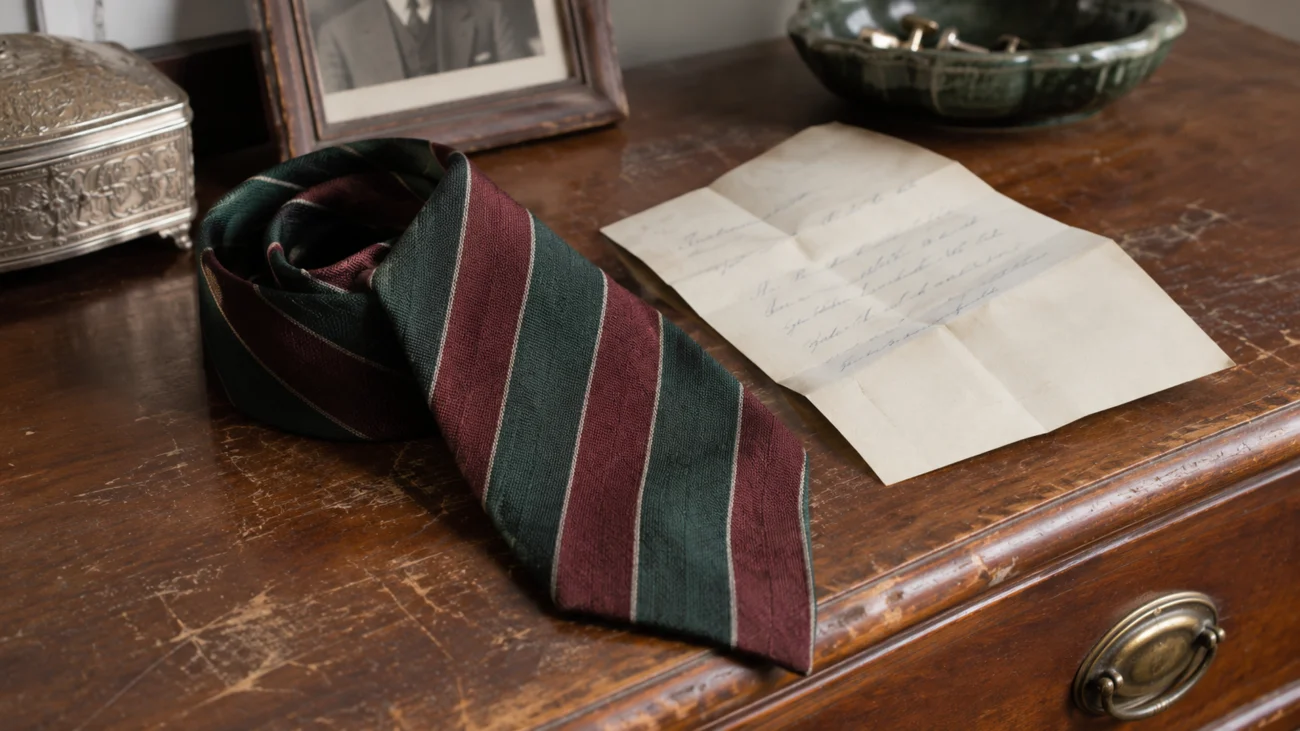
You’re going to a reunion in Canada and the tie in your hand belonged to your uncle. The note in its box names a British regiment. Before you knot it, find out two things. Does this design actually belong to the organisation he named? And whom does that organisation expect to wear this particular version? If either answer is missing on the morning of the reunion, take a different tie and keep the family one with its note.
Featured image generated with AI.
Turn the tie over before you look up the stripes
Lay the blade flat in daylight and take a picture of a whole run of the pattern. Include both edges. List the stripes in order from one distinctive band to the next occurrence of that band. Two broad colours are quite easy to remember. The thin line squeezed between them might distinguish the tie in your hand from the one your search turns up.
Now look behind the blade and along the narrow end. Photograph the maker’s label and any separate association label. A retailer’s name may tell you who sold the tie. It doesn’t identify the buyer or the basis on which he wore it. Put the family note in a separate photograph, with the writer’s name and an approximate date if the family knows them. Keep any uncertain reading of a faded word in brackets.
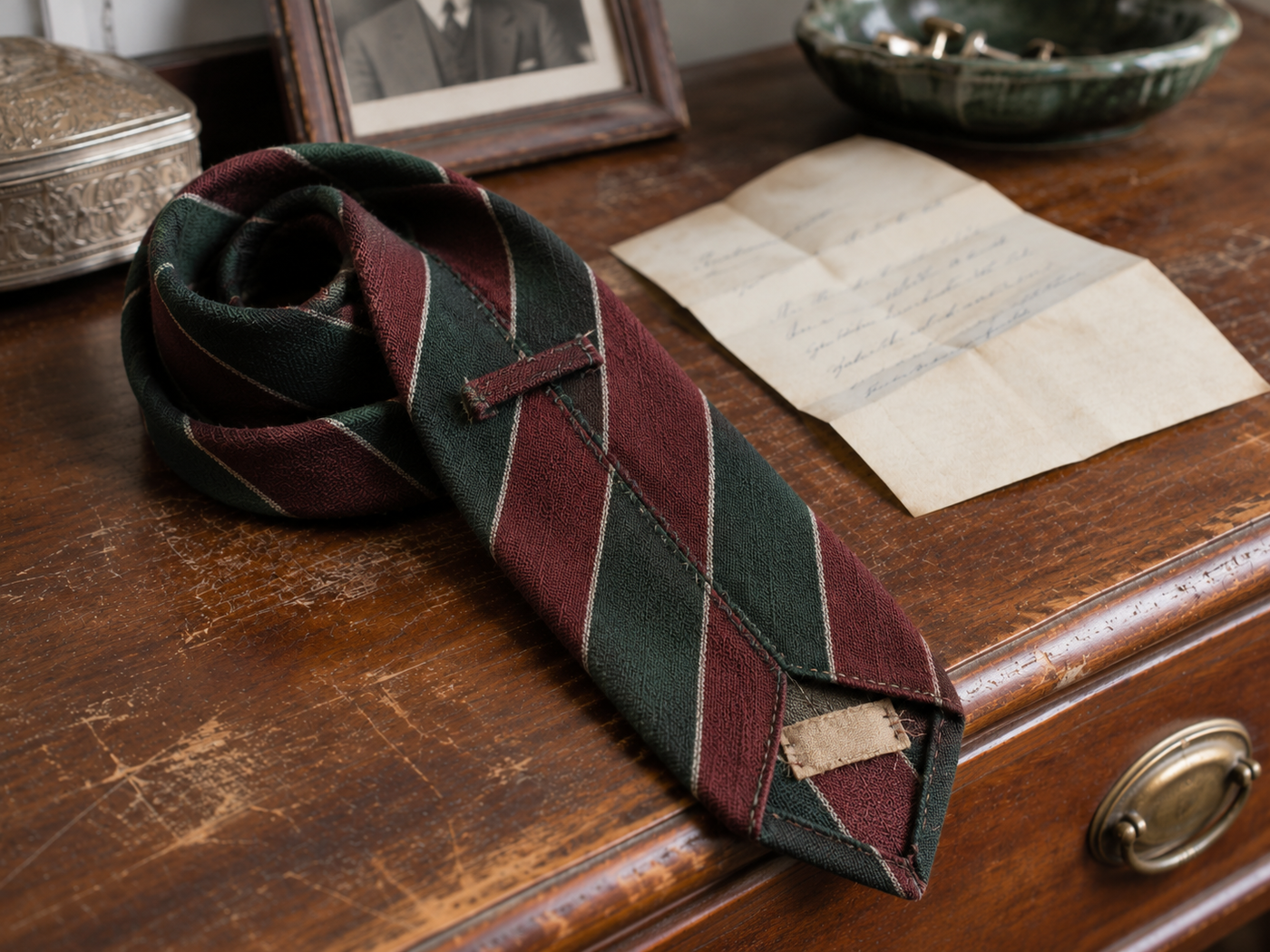
Trace the note back to the occasion. Did your uncle buy the tie while he was serving, receive it at a sports dinner or keep it as a gift from a friend? One relative may remember the presentation and another may have a photograph of him wearing it. Ask for that one memory without suggesting the answer you hope to hear. Record who told you what. There is a difference between “his daughter remembers the club dinner” and “he was awarded this tie at the dinner.”
Look for the named organisation’s own distinctions
The British Honourable Artillery Company’s guide to members’ ties shows why a general rule about regimental stripes is a poor guide to an individual tie. The HAC distinguishes a regimental tie, a non-regimental tie and sports ties. Its sports and honours designs both use diagonal stripes, but the descriptions give different arrangements and different qualifications. The company also specifies who can purchase its ties. Those are rules for the HAC. Start again with the right authority if your note names another association.
Place the official description beside your photographs. Look for a complete match, including the ground colour, repeated device if there is one, order of the bands and any designation on the back. A tie that runs diagonally the same way still needs a better identification. If the design seems to be an older issue, an archivist might recognise its date or the point at which it changed. Send the picture upright and say which end is the broad blade.
The question that matters belongs to the association secretary or equivalent contact. “This was my uncle’s. Does it match a design you issued, and what would wearing that version at this reunion indicate?” Add your own connection to the group. Family ownership supplies part of the tie’s history. It does not put your name on your uncle’s service or playing record.
Decide what goes back in the box
For a documented match, keep the dated reply with the note and follow the guidance for your own circumstances. If it turns out to be an ordinary striped tie, retain the story of who wore it even if the supposed regimental connection drops out. You may enjoy it more for the memory of a particular lunch than for any claim attached to the colours.
An unanswered enquiry also gives you a perfectly usable decision for today. Wear another tie, bring a photograph if the family would enjoy seeing it, and revisit the identification when someone can add evidence. The same distinction between the owner of an object and the person it represents comes up with inherited Canadian military medals, which have their own rules. On the tie’s card, put the identification, the source and the decision for this reunion on three separate lines. A later wearer can then change the decision without losing the story.
