
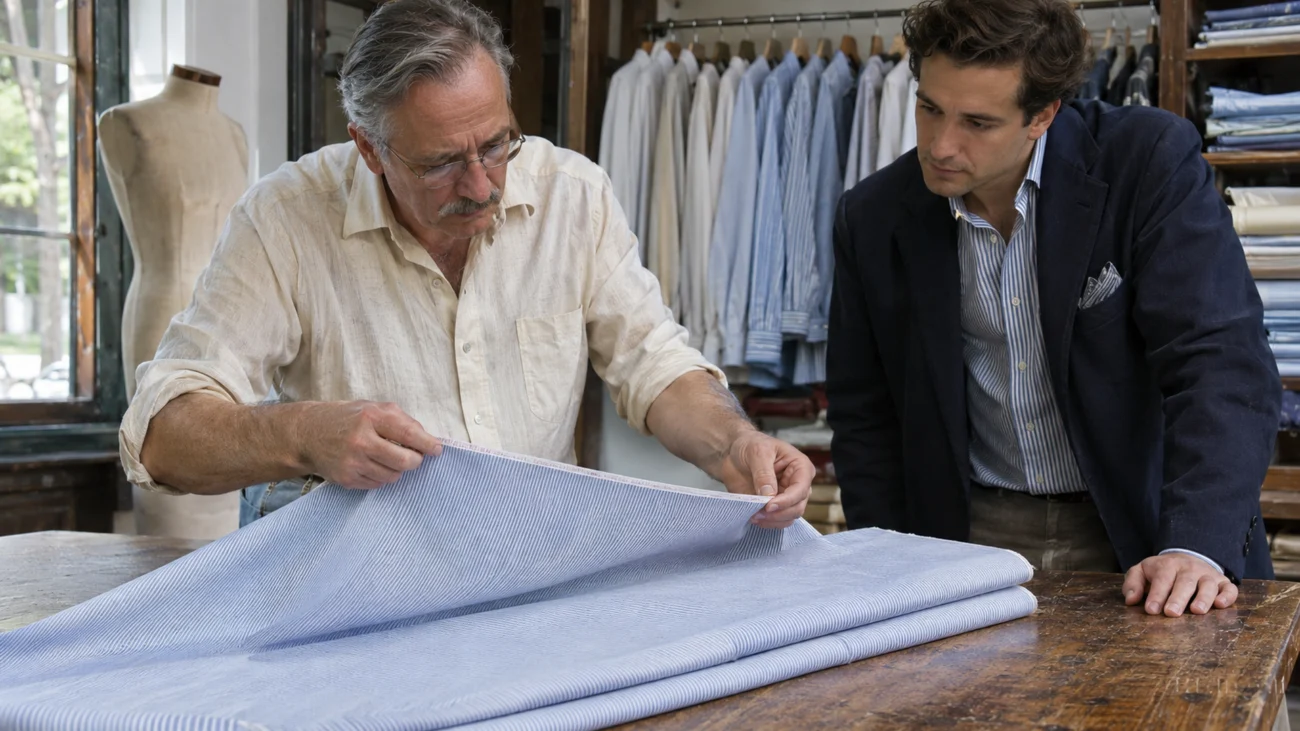
“Could you make me a shirt out of this? It was my father’s, and this is the whole piece.” Start with that question and a photograph. Some shirtmakers accept a customer’s cloth. Ask yours to confirm in writing whether they can use this length for the shirt you want. Keep the piece at home until you agree on the next step. Permission to inspect it and permission to put scissors to it are two separate decisions you get to make.
Featured image generated with AI.
Elgar Shirts’ special-order policy gives a useful example. The Welsh maker considers a customer’s cloth for garments in its range if the material suits the garment. In your first enquiry, name the shirt you want, say whether the cloth can be replaced and ask which measurements and photographs the cutter needs. That gives the shop a chance to decline before either of you has to arrange a parcel.
Unfold the whole piece
Lay the shirting flat in good light. Find the two long woven edges. Each is a selvedge, the border that was already there before anyone cut the cloth off the roll. Run your tape across, from just inside one border to just inside the other. Let it lie flat without pulling the cloth taut. Write down that usable width and the unit on the tape. If the maker also wants the width including the borders, give it on a separate line.
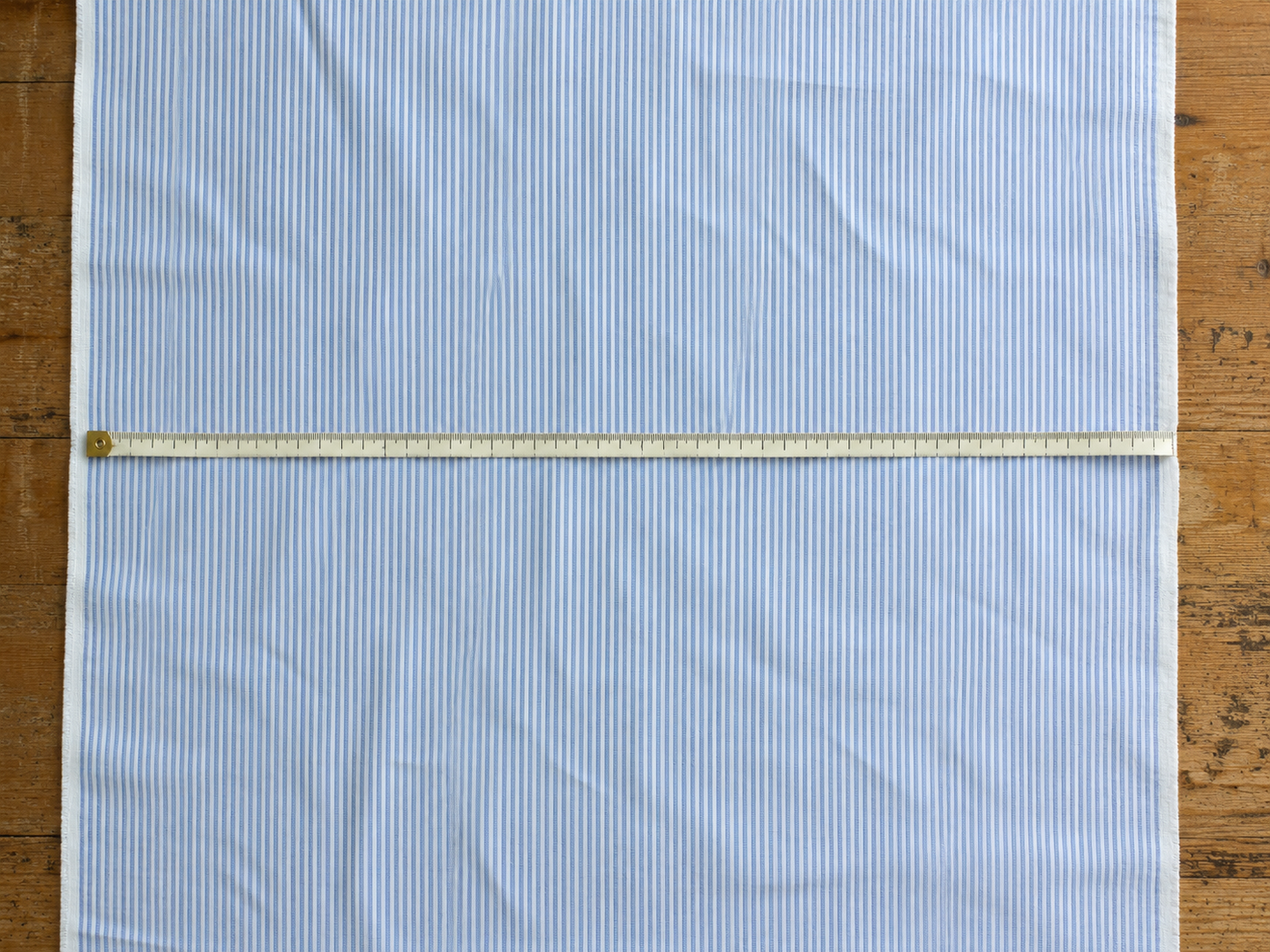
Follow a woven edge to measure the length. Check both cut ends. If one slopes or has a square missing from a corner, give the shorter uninterrupted length and sketch the extra piece beside it. Two pieces need two sets of dimensions. A cutter seeing “two metres” needs to know if that means one continuous length or a pair of metre-long pieces with a cut between them.
Photograph the complete piece, then each flaw with a ruler beside it. Give a mark a location someone else can find, such as “12 inches (30.48 cm) in from the left border, halfway along the length, face up as pictured.” Include the stripe direction. If the edge bears a name or number, record the woven edge markings while they’re intact. If the fibre content or washing history is a guess, say what you know and leave the rest open.
Give the cutter a shirt to lay out
“Long sleeves, one chest pocket, stripes running down the front” tells the cutter more than “a shirt in my size.” Mention any stripe you want to line up at the pocket. The cutter needs enough sound cloth in the right places for both fronts, the sleeves and the smaller pieces. Shifting a pocket until its stripes meet the front can change where that pocket fits on the length. Your measurements describe what you have. The cutter can lay your size and design against them.
The shoulder panel is another place to settle direction early. If you want the stripes to meet at an angle across the upper back, attach a sketch of the stripe arrangement on a split yoke. Ask whether there’s room to cut it that way around the flaw you photographed. If the flaw rules that out, ask the cutter to sketch a second layout. Would you still want that shirt?
Agree on the last cut as well as the first
Ask who prepares the cloth, whether the shop needs to see it in person, what the work costs and who pays return carriage if it’s unsuitable. Wait for preparation instructions before washing, pressing or cutting off a sample. If the decision depends on handling the piece, get written acceptance for inspection only, with a return address. Ask the cutter to contact you after inspection with a yes or a no for the proposed shirt.
Agree on what comes back. You might want the longest offcut for a future repair or a short piece with the woven name as a keepsake. If you want to compare two stitching distances on a cuff, ask to see the shop’s existing samples first. That leaves every inch of your own cloth available until the cutter knows what the shirt will use. Keep the dated reply with the photographs. Here’s a two-line order note to adapt.
Blue striped family shirting, one piece, usable width [measurement and unit], uninterrupted length [measurement and unit]. Flaw and stripe direction as pictured. Please confirm design, fee and preparation in writing.
Inspection only until I approve the cutter’s layout in writing. If the piece is short, stop and contact me. Return all offcuts, including the marked edge, to [return address].

One thought on “Can You Bring Your Own Cloth to a Shirtmaker?”