

Watch the character arrive, then watch them come back to a comparable room later in the story. If you notice a change in the clothes, find a third scene that helps explain it. Record what stayed visible, what changed and what the character was doing. Then choose one small part of the change to try in your own life. A three-scene reading can lead to a useful dressing decision even when you have no evidence about what a designer intended.
Featured image generated with AI.
Start with something you can see clearly while the film is playing at its normal pace. The opening of an overshirt, the way a collar sits over a second layer or the repeated line of a pocket flap can carry from one scene to another. A remembered impression such as “he grew more confident” is worth investigating. Turn it back into observable things before you take it to your wardrobe.
Choose scenes that ask something different of the wearer
Use an authorised copy and identify the version you watched. Write down three actions in story order, adding a time reference for your copy. Choose scenes where the character’s relationship to the room changes: arriving to observe, working alongside someone, returning to lead a discussion. Three views of a single conversation may give excellent coverage of a jacket while telling you little about change over time.
Check for a flashback, parallel story or montage before calling one appearance “later”. Describe the order in which the audience sees the scenes and, where you can establish it, the order the character experiences them. If the chronology remains deliberately uncertain, organise your notes around the three situations. The clothes can create a meaningful contrast without proving that a particular number of days has passed.
Give each scene a short name tied to an action. “Doorway”, “worktable” and “meeting” will help you relocate the evidence when your first reading changes. Note who else is present and whether the character is listening, doing the work or addressing the group. The same open collar can look hesitant in a close shot at a doorway and perfectly at ease in a wide shot of a familiar room.
Pick one feature that survives the frame
In an imagined story a new employee arrives wearing a green overshirt with a buttoned chest-pocket flap. The pocket has a long horizontal edge that makes the shirt easy to recognise on screen. At the worktable the camera still shows the pocket but the sleeves are turned, the front is open and the cloth looks more worn. At a meeting the familiar shirt appears over a darker layer. You can follow one recognisable outline through all three situations.
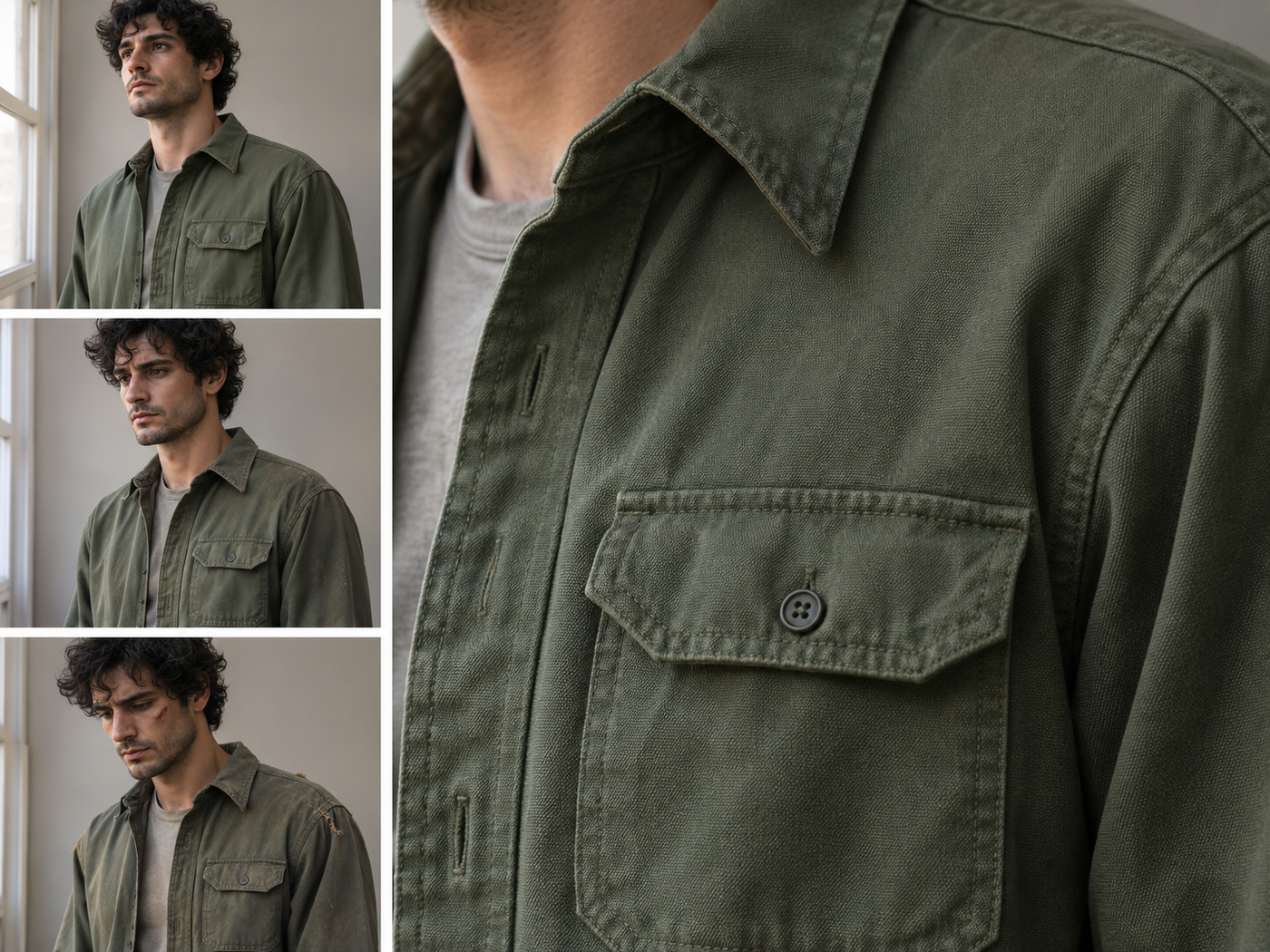
Describe the earliest view in enough detail to compare it later. Is the outer layer open at the throat? What fills the space between the two front edges? Can you see the collar of the underlayer, or just a pale triangle? Give colour words only as precisely as the light and copy allow. If the scene is lit by a greenish window, a note about light and dark may survive a comparison better than a confident claim about dye.
Draw a simple outline in the margin and mark the boundaries outside the frame. The camera might show a pocket and a shoulder but never show the hem. Leave the hem open. If the character appears to be wearing the same shirt in another scene, describe it as the recurring screen design unless you have evidence that the production used the very same physical garment. Visual continuity can survive a change of physical copy.
Change one line of the note at a time
Return to the second scene and compare the same side of the garment in a similar pose. First note what remains: pocket outline, collar shape, rough value of the cloth. Then note the difference you can actually identify: a turned sleeve, a dark underlayer, a fastened front. Finally put a verb beside the change. The wearer is reaching, addressing someone, taking off a layer or standing still while other people move.
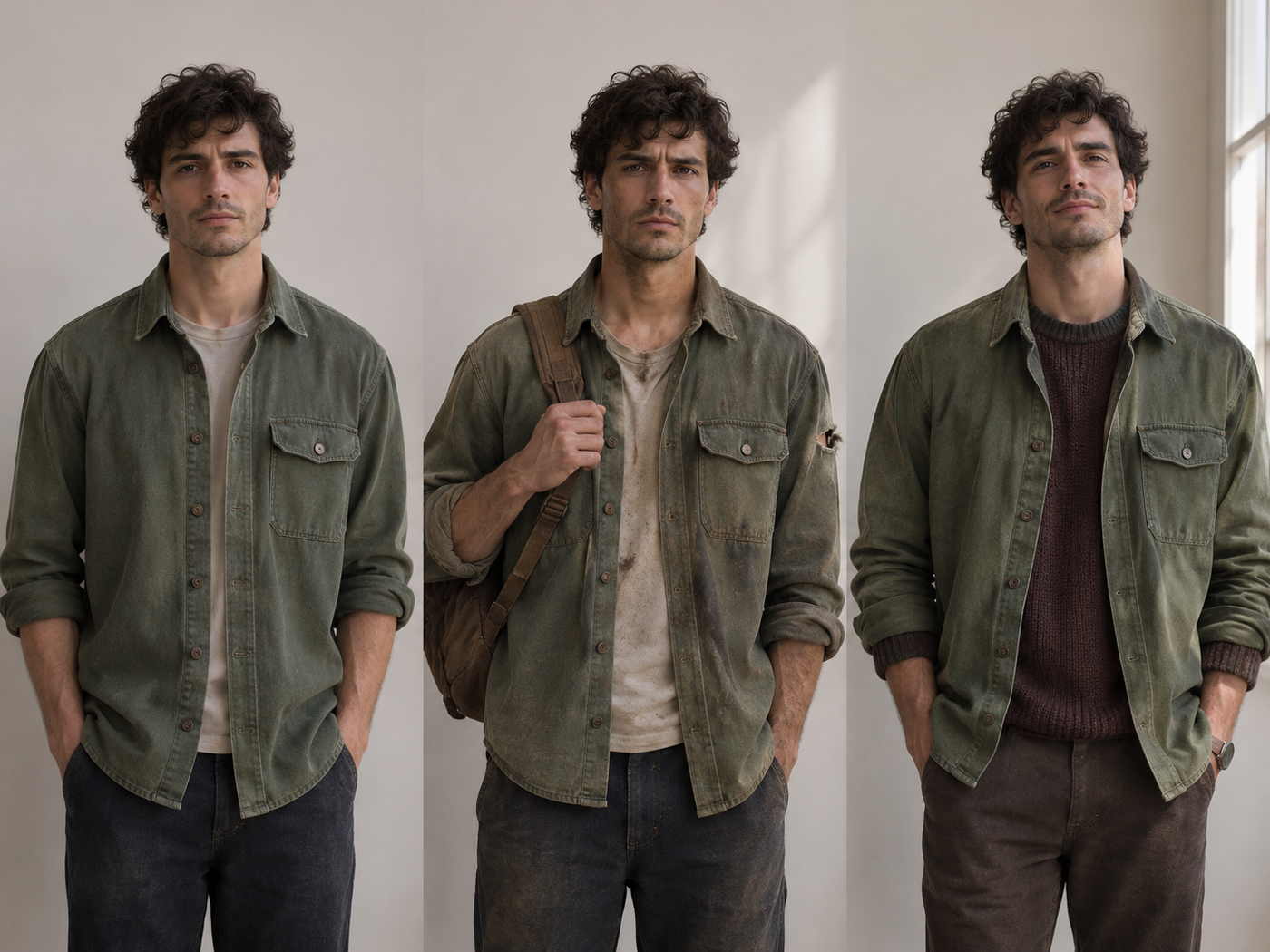
Now ask what else in the shot might explain the effect. The second room could be warmer, the work could require clear forearms or the camera could have moved from a full-length view to a close-up. In the worktable scene a sleeve turned out of the way may tell us quite directly about the task. Reading it as evidence of increased confidence needs support from the character’s behaviour as well as the garment.
The third scene is useful precisely because it can upset the tidy story you began to tell. Suppose the sleeves are back down at the meeting, yet the character appears more comfortable speaking. Perhaps it is the open layer over a collared shirt that gives the meeting a different feeling. Or perhaps the performance does most of the work and the familiar overshirt simply makes the person recognisable. Write both readings and decide which details each accounts for.
Give the interpretation an owner
Costume can contribute to the way an audience understands a character. The Academy’s teaching material on costume design treats clothing in relation to story and character. Its framework gives you permission to look closely, but an assertion about why the designer of a particular film chose a particular shirt needs a source from that production. Present your own reading in the first person of a viewer: “I read the repeated work shirt as a sign that this person still belongs to the workshop.” Academy of Motion Picture Arts and Sciences’ costume design teaching guide
A direct interview may supply a designer’s explanation. Record the exact scene or character it concerns. A statement about the film’s palette is evidence about the palette; it need not settle why a pocket is buttoned in a single shot. If you want to identify who made the actual garment, follow the screen credit to an object-level record. The authorship enquiry can proceed alongside your viewing notes without deciding your interpretation for you.
Try a counterexample from the same film. Does the character wear the open overshirt in another situation where they are plainly uncertain? If so, temper the claim. Perhaps the shirt identifies a working environment and posture changes its meaning. You have learned something more specific than “open clothes mean relaxed”. Keep the counterexample with the three principal scenes so someone else can see how you reached the reading.
Carry one change into a real room
Imagine giving a presentation to colleagues who usually see you at a bench or in a studio. You want to look ready to lead while still looking recognisably like the person who works alongside them. Choose your own familiar overshirt. Try it open over a plain base layer, then open over a shirt with a visible collar. Keep your trousers, shoes and the outer shirt the same. Notice which version gives your face the frame you want.

Stand where the presentation will actually happen if you can. Look at a test photograph from the distance of a colleague near the back. Sit to answer a question, reach towards a drawing and look again. The effect you admired may depend on a camera close to the face. If it disappears across the room, decide whether the private feeling of the combination is sufficient or whether another small change would work better.
A performance can also make the movement of clothes the memorable detail. If the changing silhouette appears only as someone steps or raises an arm, study how movement changes a stage silhouette before settling on a static outline. For an ordinary presentation, try the movement you will actually use. A theatrical scale that serves a filmed performance may overwhelm the sightline between you and a seated colleague.
A three-scene note you can keep
- For the first appearance, name the scene, visible feature, action and framing. Draw the one part that will let you recognise the design again.
- For the second and third, record one repeated feature and one change. Note a competing explanation such as light, temperature, activity or camera position. Attribute any production explanation to its actual source.
- End with your occasion, the impression you want and the single garment decision you can test. Record what happened in the room, including a version you decided to leave at home.
A completed last line might read, “The pocket made the overshirt familiar each time the character returned. For my meeting I kept my own work shirt and changed the layer inside it. The pale collar remained visible from a chair at the far end of the table.” That gives the film its own story and gives you a change small enough to test again tomorrow.